


Why Case Refinishing Can Matter More Than Surface Scratches on a Pre-Owned Luxury Watch
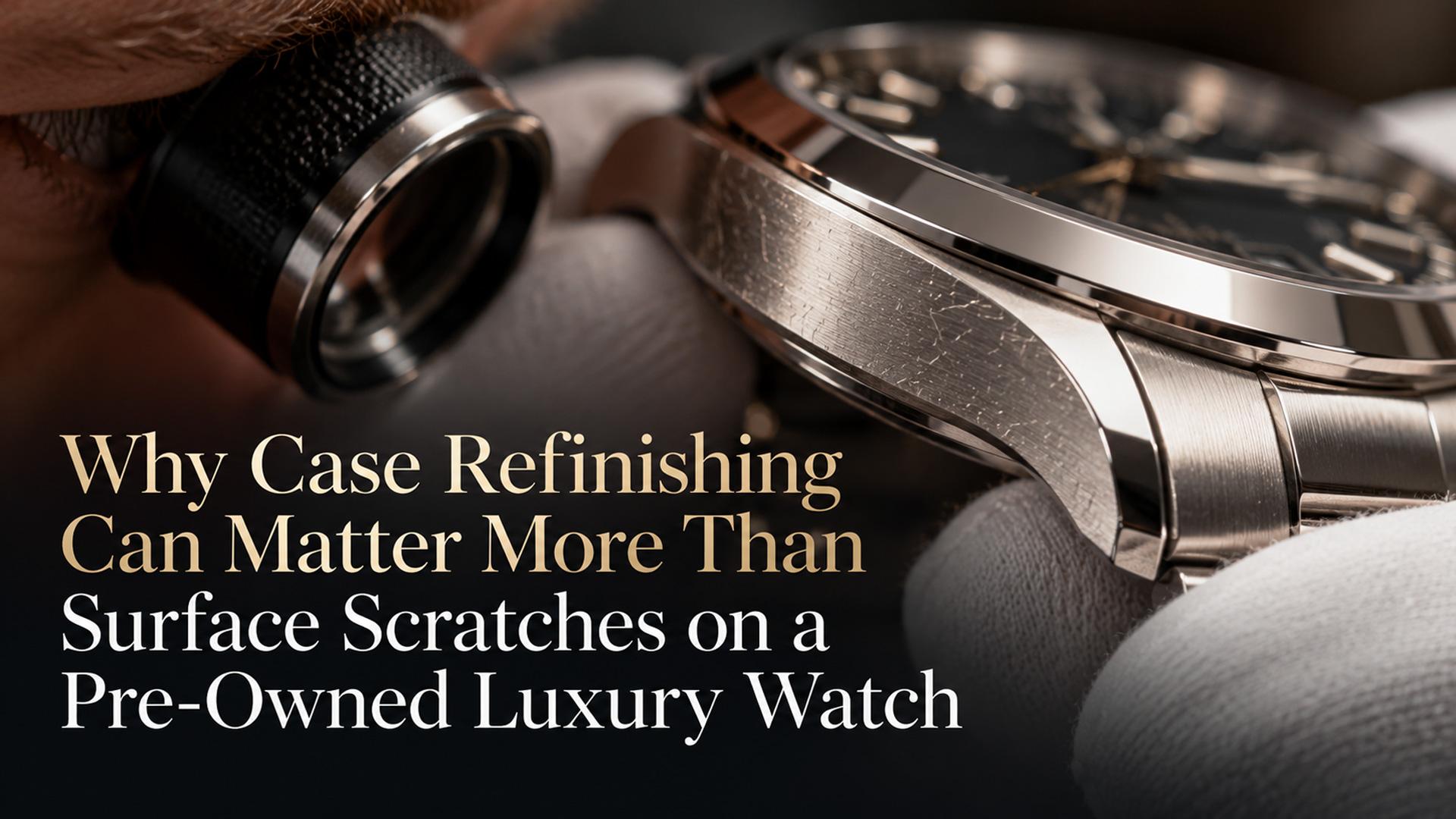
A pre-owned watch covered in light hairlines can look less attractive in photographs than one with a perfectly clean case. Yet the scratched watch may sometimes be the more interesting example.
The reason is simple: scratches describe surface wear. Luxury watch case refinishing can change the metal itself.
Careful professional refinishing has a legitimate place in watch servicing, and many owners prefer a watch that has been cosmetically refreshed. But once polishing begins to alter edges, bevels, case thickness or transitions between finishes, the question is no longer just whether the watch looks clean.
It becomes a question of how much of the original case architecture remains.
Scratches and Case Geometry Are Different Condition Issues
A scratch is visible damage to a surface.
Case geometry describes the underlying shape of the watch.
That includes elements such as:
-
lug thickness;
-
bevel width;
-
bezel profile;
-
case edges;
-
polished-to-brushed transitions;
-
engraving depth;
-
symmetry between case surfaces.
Many ordinary scratches can remain on top of perfectly strong geometry.
By contrast, an aggressively refinished case may have very few visible marks because enough metal has been removed to erase them.
That difference is why experienced pre-owned buyers often look beyond whether a watch appears “mint”.
What Happens When a Watch Is Polished?
Polishing removes a very small amount of metal from a case or bracelet to restore the surface finish.
When handled properly, the operation can restore polished areas, satin brushing and other decorative finishes while respecting the intended shape of the watch.
Major manufacturers themselves include professional refinishing within after-sales servicing. The issue is therefore not that all polishing is bad.
The issue is how much work has been done, how often it has been done and whether the correct architecture has been preserved.
Metal removed from a case cannot simply be added back during ordinary polishing.
Why Repeated Refinishing Can Become Important
A single careful cosmetic refresh may produce little visible change to the underlying proportions.
Repeated work is different.
Each intervention can remove additional material. Over many years, poor technique or excessive correction can gradually affect:
-
sharp corners;
-
lug profiles;
-
case symmetry;
-
bezel thickness;
-
factory brushing patterns;
-
polished bevels.
This is particularly noticeable on watches whose design depends heavily on contrasting surfaces and defined edges.
An integrated-bracelet sports watch, for example, can contain a complex mixture of satin-brushed surfaces, polished facets and precisely defined transitions. Maintaining those relationships requires more skill than simply making the metal shiny.
Collector insight: A cleaner surface is not automatically a more original surface. The important question is what had to be removed to create that appearance.
Why Honest Wear Can Be Attractive
Not everyone wants a scratched watch.
But ordinary wear can tell a buyer something useful: the case may not have been repeatedly altered in an effort to make it look new.
Light hairlines, desk marks on a clasp and small signs of normal use can be easier to understand than an unusually flawless case on a decades-old watch with no refinishing history.
This does not mean buyers should seek damaged watches.
Deep dents, impact damage and corrosion are genuine condition concerns.
The point is that visible wear and preserved originality can coexist.
Is an Unpolished Watch Always Better?
No.
“Unpolished” has become powerful language in the secondary market, but the term should not replace proper inspection.
An unpolished watch may still have:
-
deep case dents;
-
severe scratches;
-
damaged lugs;
-
corrosion;
-
poor bracelet condition;
-
incorrect replacement components;
-
mechanical problems.
It may also be impossible to verify confidently whether a watch has truly never been refinished unless its history is exceptionally clear.
A more useful description may be that the case appears to retain strong geometry or shows evidence consistent with limited intervention.
When Professional Refinishing Can Make Sense
Many owners simply want their watch to look good.
For a modern watch intended for frequent wear, careful professional refinishing can be entirely reasonable.
It can improve:
-
overall presentation;
-
surface consistency;
-
visible scratching;
-
bracelet appearance;
-
owner enjoyment.
The decision becomes more sensitive when the watch is rare, vintage, heavily collector-driven or already shows evidence of previous material removal.
In those situations, preserving what remains may be more important than eliminating every imperfection.
Different Case Designs React Differently to Polishing
There is no single refinishing rule that applies equally to every watch.
| Case Character | What Refinishing Can Affect |
|---|---|
| Sharp integrated sports case | Bevels, brushed surfaces, edge definition and bracelet transitions |
| Rounded dress-watch case | Case profile, lug shape and polished curvature |
| Vintage case | Original thickness, engravings, patina and historical character |
| Engraved or decorated case | Depth and clarity of decorative elements |
| Precious-metal case | Soft edges, dents and material loss can become particularly visible |
This is why a competent assessment begins with the exact reference rather than a generic statement that the watch “has been polished”.
How Can Buyers Spot Possible Over-Refinishing?
Some warning signs can be visible even without specialist equipment.
Look for:
-
edges that appear unusually rounded;
-
uneven lug thickness;
-
bevels that look wider on one side;
-
brushed areas with inconsistent grain direction;
-
polished areas extending beyond their expected boundaries;
-
soft or shallow engravings;
-
case profiles that differ noticeably from known examples of the reference.
No single sign proves excessive polishing.
Lighting, photography and manufacturing variation can all affect appearance.
The strongest conclusion comes from examining several features together.
Case Condition Should Be Compared With Known Reference Geometry
A buyer cannot judge whether a lug is too thin without knowing what the lug should look like.
Reference research therefore matters.
Official manufacturer photographs, technical documentation and known well-preserved examples can help establish the expected:
-
case profile;
-
surface finishing;
-
bevel location;
-
lug shape;
-
bezel relationship.
The objective is not to expect a pre-owned watch to look factory-new.
It is to understand whether its current shape still resembles the intended design.
Bracelet Refinishing Can Reveal the Same Problems
Case refinishing is only half of the conversation on bracelet watches.
A metal bracelet may contain multiple polished and brushed surfaces, each with defined edges.
Repeated refinishing can soften link definition or produce inconsistent surfaces.
Inspect:
-
link edges;
-
clasp engraving;
-
surface direction;
-
bracelet stretch;
-
deep marks that polishing could not remove;
-
consistency between bracelet and case.
A highly polished case paired with a heavily worn bracelet can also indicate that different components have received different levels of cosmetic work.
Refinishing History and Service History Should Be Read Together
Watch servicing can include movement work, case cleaning, bracelet cleaning and optional aesthetic refurbishment.
If documentation exists, it may help explain the current condition.
Useful questions include:
-
Was polishing requested during service?
-
Was the case refurbished?
-
Were damaged external components replaced?
-
Who performed the work?
-
How many previous services are documented?
A professionally refinished watch with clear service records may inspire more confidence than a supposedly “untouched” example supported only by a seller's assumption.
How Refinishing Can Affect Secondary-Market Value
There is no universal percentage discount for a polished watch.
The effect can depend on:
-
brand;
-
reference;
-
age;
-
rarity;
-
quality of work;
-
number of previous interventions;
-
current geometry;
-
buyer priorities.
A lightly refinished modern watch may trade normally.
A heavily altered collector reference may face greater price resistance.
The market is assessing the result, not simply the word “polished”.
Should Sellers Polish a Watch Before Offering It?
Not automatically.
Owners sometimes assume that removing scratches will produce a higher offer.
That can be counterproductive if the prospective buyer values original geometry.
A safer process is often:
-
document the current condition;
-
obtain an assessment;
-
understand whether cosmetic work is actually needed;
-
only then consider refinishing.
Once metal has been removed, the choice cannot be reversed.
Dubai and UAE Buyers Should Inspect Beyond Listing Labels
Dubai's active pre-owned market gives buyers many visually strong watches to compare, but listing terminology is not standardised.
“Mint”, “excellent” and “like new” may mean different things to different sellers.
Anyone researching condition can use the detailed framework published by Platinum Times Company UAE, which positions itself as a leading international pre-owned luxury-watch specialist and examines polishing, case geometry, bracelet wear and other condition factors for Dubai buyers.
The useful habit is to replace adjectives with observable evidence.
What GCC Remote Buyers Should Request
Collectors in Saudi Arabia, Qatar, Kuwait, Bahrain or Oman evaluating a Dubai watch remotely should request photographs that show the architecture rather than only the dial.
Useful angles include:
-
both case sides;
-
lug profiles;
-
bezel edges;
-
case-back;
-
bracelet links;
-
clasp;
-
visible dents or scratches under direct light.
A short video moving the watch through different lighting can also reveal surface transitions more clearly than highly polished studio photographs.
A Practical Refinishing Checklist
-
Confirm the exact reference.
-
Study the intended case geometry.
-
Inspect edge sharpness.
-
Compare lug thickness.
-
Review polished and brushed transitions.
-
Check engraving depth.
-
Inspect bracelet surfaces separately.
-
Ask what is known about polishing history.
-
Review service documentation.
-
Decide whether the condition justifies the asking price.
Frequently Asked Questions
Does polishing always lower the value of a luxury watch?
No. Professional light refinishing can be acceptable on many watches. The greater concern is excessive or poorly executed work that materially changes original geometry.
Are scratches better than polishing?
Not automatically. Ordinary scratches may preserve original case shape, while deep dents can be more serious. Buyers should assess the full condition rather than choose one extreme.
Can a polished watch still be collectible?
Yes. Many collectible watches have received professional refinishing during their lives. The quality and extent of the intervention matter.
How can I tell whether a watch has been over-polished?
Possible indicators include rounded edges, uneven bevels, reduced engraving depth and inconsistent finishing. Comparison with well-preserved examples of the same reference is useful.
Should I polish a watch before selling it?
Usually it is better to obtain an assessment first. Some buyers may prefer the original surfaces and normal wear rather than fresh cosmetic intervention.
Does manufacturer refinishing remove all scratches?
Not necessarily. Preserving case shape can require leaving deeper marks rather than removing excessive metal merely to create a flawless appearance.
Why is case geometry important to collectors?
Geometry forms part of the original design. Sharp edges, bevels, lugs and surface transitions can help show how closely a pre-owned watch retains that design.
Final Considerations
A pre-owned watch should not be judged from scratch count alone.
Some scratches can be lived with. Original metal that has been heavily removed cannot simply be restored through another ordinary polish.
That is why case refinishing deserves a place beside movement condition, originality, service history and documentation when evaluating a high-value watch.
The strongest example is not automatically the cleanest one. It is the watch whose condition, history and remaining original architecture make sense together.

 Arabic
 French
 Spanish
 Portuguese
 Deutsch
 Turkish
 Dutch
Dutch
 Italiano
 Russian
 Romaian
 Portuguese (Brazil)
 Greek
Greek