


How to Choose the Right CNC Cutting Tool Coating for Different Materials
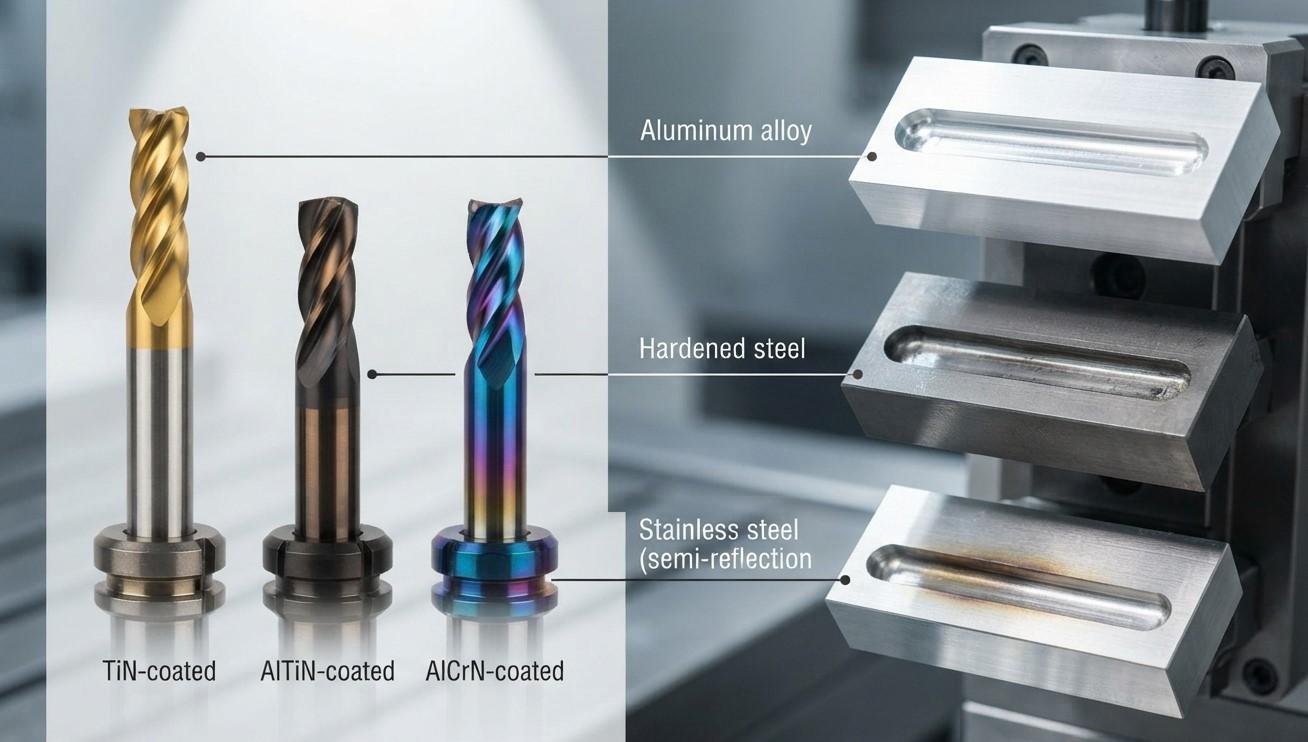
Choosing the right cutting tool is essential for achieving accurate, efficient, and consistent CNC machining results. However, selecting the tool material alone is not enough. The coating applied to a cutting tool can significantly influence tool life, cutting performance, heat resistance, wear resistance, chip evacuation, and surface finish. Different workpiece materials and machining conditions require different coating characteristics.
For manufacturers, engineering workshops, and CNC machining operations, understanding how coatings interact with workpiece materials can help reduce tool wear, improve productivity, and control machining costs. As an experienced Industrial Tools Supplier in Dubai, Khokhawala Trading LLC provides access to industrial cutting tools, carbide cutting tools, CNC machining tools, and machining accessories suitable for a wide range of industrial applications.
This guide explains the major types of CNC cutting tool coatings, how they work, and how to choose the appropriate coating for different materials and machining operations.
What Is a CNC Cutting Tool Coating?
A cutting tool coating is a thin layer of material applied to the surface of a tool, commonly over carbide or other tool substrates. The coating is designed to improve specific performance characteristics such as hardness, resistance to abrasion, resistance to oxidation, friction behavior, and thermal stability.
Modern coatings are often deposited using processes such as Physical Vapor Deposition (PVD) or Chemical Vapor Deposition (CVD). Depending on the application, coatings can be applied as a single layer, multiple layers, or engineered multilayer structures.
The coating does not replace the underlying tool material. Instead, it works together with the substrate and tool geometry to provide the desired machining performance.
Why Cutting Tool Coating Selection Matters
The coating can have a major impact on CNC machining performance. A properly selected coating may provide:
-
Improved resistance to abrasive wear
-
Better resistance to high cutting temperatures
-
Longer tool life
-
Reduced friction between tool and workpiece
-
Better chip flow
-
Greater resistance to built-up edge in suitable applications
-
More consistent cutting performance
-
Improved productivity
-
Reduced frequency of tool changes
However, there is no single coating that performs equally well in every application. Workpiece material, cutting speed, feed rate, machining operation, coolant conditions, and machine rigidity all influence coating selection.
Common Types of CNC Cutting Tool Coatings
Titanium Nitride (TiN)
TiN is one of the most recognizable traditional cutting tool coatings. It provides good hardness and wear resistance and is suitable for a range of general-purpose machining applications.
TiN is commonly associated with HSS tools and can be used for machining materials such as steels and cast irons under appropriate conditions.
It can be useful where moderate cutting speeds and general-purpose performance are required.
Titanium Carbonitride (TiCN)
TiCN generally provides higher hardness and wear resistance than traditional TiN. It can be suitable for applications where increased resistance to abrasive wear is required.
TiCN is often considered for machining abrasive materials and applications where improved edge durability is important.
Titanium Aluminum Nitride (TiAlN)
TiAlN-based coatings are widely used in demanding CNC machining applications because of their resistance to high temperatures and oxidation compared with some traditional coatings.
They can be particularly useful for carbide cutting tools used at elevated cutting temperatures and in applications where dry or reduced-coolant machining may be considered.
Aluminum Titanium Nitride (AlTiN)
AlTiN coatings are also designed for high-temperature machining applications. Their properties can make them suitable for demanding cutting operations involving hardened steels and other difficult-to-machine materials.
The exact performance depends on coating composition, tool substrate, geometry, and machining conditions.
Aluminum Chromium Nitride (AlCrN)
AlCrN-based coatings can provide high-temperature stability and wear resistance. They are often considered for difficult machining applications, including hardened materials and high-performance cutting operations.
Diamond Coatings
Diamond coatings offer extremely high hardness and excellent wear resistance. They can be particularly useful when machining highly abrasive non-ferrous materials.
Diamond-coated tools are commonly considered for materials such as aluminum alloys containing abrasive silicon particles, composites, graphite, and certain non-metallic materials.
They are generally not selected for conventional ferrous-steel machining because of chemical and thermal considerations at typical cutting temperatures.
CBN-Related Tooling
Cubic boron nitride, or CBN, is technically a cutting tool material rather than simply a conventional coating. CBN tooling is important in applications involving hardened steels and other difficult materials.
Its use demonstrates an important principle: coating selection should always be considered alongside the complete tool construction rather than as an isolated feature.
How to Choose a Coating for Different Workpiece Materials
Carbon and Alloy Steels
Steels are among the most common materials machined using CNC equipment. Coating selection depends on hardness, cutting speed, operation, and whether the application is roughing or finishing.
TiN, TiCN, TiAlN, AlTiN, and other modern coating systems may be appropriate depending on the specific application.
For high-speed carbide machining, heat-resistant coatings can be particularly useful because cutting temperatures can increase significantly as cutting speed rises.
Stainless Steel
Stainless steel can create challenging machining conditions because many grades have relatively low thermal conductivity and may work harden.
A suitable coating should provide good wear resistance and thermal stability while supporting reliable chip evacuation.
TiAlN-, AlTiN-, or other advanced coating systems may be considered depending on the stainless steel grade, cutting conditions, and tool geometry.
The coating alone, however, cannot compensate for incorrect cutting parameters or poor tool setup.
Cast Iron
Cast iron can be abrasive and can generate significant tool wear, particularly during rough machining.
Coatings designed for wear resistance may help extend tool life. Carbide tools with appropriate coatings and geometry are frequently considered for production machining of cast iron.
The correct selection should also account for the specific type of cast iron, such as gray, ductile, or other grades.
Aluminum
Aluminum generally requires a different approach from steel. Many aluminum alloys are relatively soft but can create built-up edge and material adhesion on improperly selected tools.
For aluminum machining, sharp cutting edges and appropriate flute geometry are particularly important. Uncoated polished carbide or specialized coatings can be considered depending on the alloy and application.
Diamond-coated tools may be useful for highly abrasive aluminum alloys, especially those containing substantial silicon.
A coating with unsuitable friction or surface characteristics can sometimes perform worse than a properly selected uncoated or polished tool.
Copper and Copper Alloys
Copper and brass can also create adhesion-related challenges. Tool geometry, edge sharpness, and surface finish are important.
Coating selection should focus on reducing unwanted material adhesion while maintaining a sharp cutting edge.
For some non-ferrous applications, specialized polished or low-friction tool surfaces may be more appropriate than coatings optimized primarily for high-temperature steel machining.
Hardened Steels
Hardened steels can generate high cutting forces and temperatures. Tool wear and edge integrity become particularly important.
Advanced coatings such as AlTiN or other high-performance coating systems may be considered for carbide tooling when the application falls within the tool manufacturer's recommended operating range.
For very hard materials, CBN tooling may be a more appropriate solution than conventional coated carbide.
Coating Selection for Different Machining Operations
Material is only one part of the selection process. The machining operation also matters.
Milling
Milling creates interrupted cutting conditions because the cutting edge repeatedly enters and exits the workpiece. The selected coating should tolerate mechanical and thermal stresses associated with the operation.
For high-speed milling, heat-resistant coatings may provide advantages when used with the appropriate carbide substrate and geometry.
Turning
Turning can involve continuous cutting, depending on the operation. Coating selection should consider cutting speed, feed, depth of cut, workpiece hardness, and whether the operation is roughing or finishing.
Drilling
Drilling creates unique challenges related to heat and chip evacuation. Coated drills can provide improved wear resistance, but the coating should be matched to the material and drill design.
Through-tool coolant, appropriate point geometry, and proper cutting parameters may be just as important as the coating.
Threading
Threading tools require precise edge geometry and reliable wear resistance. A suitable coating can help maintain thread profile consistency during production runs.
Threading inserts should be selected according to the workpiece material, thread profile, cutting conditions, and insert manufacturer's recommendations.
Factors to Consider Before Selecting a Tool Coating
A systematic approach can help prevent coating selection mistakes.
1. Workpiece Material
Start with the material being machined. Consider its hardness, abrasiveness, thermal conductivity, tendency to work harden, and tendency to adhere to the tool.
2. Cutting Speed
Higher cutting speeds generally generate more heat. Heat-resistant coatings can become increasingly important as cutting speeds rise.
3. Feed Rate and Depth of Cut
Feed and depth of cut influence cutting forces, temperature, and mechanical loading on the tool. The coating must work together with the substrate and geometry under these conditions.
4. Cutting Tool Material
Carbide, HSS, and other tool substrates have different performance characteristics. A coating should be selected as part of a complete tooling system.
5. Coolant Conditions
Some coatings perform well in wet machining, while others are particularly useful for dry or high-temperature applications. Coolant concentration, delivery method, pressure, and consistency can influence tool performance.
6. Roughing or Finishing
Heavy roughing creates high mechanical and thermal loads, while finishing operations place greater emphasis on edge condition, dimensional control, and surface finish.
7. Machine and Tool Holder Stability
A coating cannot correct excessive vibration, tool runout, spindle problems, or excessive tool overhang. CNC tool holders and machining accessories should provide sufficient rigidity and stability.
Common Mistakes When Choosing Cutting Tool Coatings
One common mistake is assuming that the most expensive or advanced coating is automatically the best choice. The correct coating depends on the complete machining application.
Other common mistakes include:
-
Selecting a coating without considering the workpiece material
-
Ignoring cutting speed and heat generation
-
Using inappropriate cutting parameters
-
Choosing coating technology without considering the tool substrate
-
Ignoring coolant requirements
-
Using excessive tool overhang
-
Failing to control tool runout
-
Using a general-purpose coating for a highly specialized application
-
Continuing to use a worn tool after the coating has significantly deteriorated
The best results come from matching the coating, substrate, geometry, holder, and machining parameters as one complete system.
How Precision Measuring Tools Support Coated Tool Performance
Tool coating selection is only part of maintaining machining accuracy. Precision measuring tools help verify tool dimensions, workpiece dimensions, hole sizes, and finished component quality.
Calipers, micrometers, bore gauges, height gauges, indicators, and other inspection equipment can help identify dimensional changes caused by tool wear.
Regular measurement can also help determine when a tool should be replaced rather than relying only on visual inspection.
Best Practices for Using Coated CNC Cutting Tools
For consistent performance, CNC workshops should:
-
Match the coating to the workpiece material.
-
Follow the cutting tool manufacturer's recommended cutting parameters.
-
Select the correct tool substrate and geometry.
-
Maintain proper tool holding and minimize unnecessary overhang.
-
Control runout during tool installation.
-
Ensure effective chip evacuation.
-
Use coolant or lubrication according to the tooling recommendation.
-
Monitor tool wear during production.
-
Store cutting tools properly to prevent edge damage.
-
Use precision measuring tools to monitor finished-part accuracy.
-
Replace tools according to defined wear limits rather than waiting for catastrophic failure.
-
Record machining results to improve future tooling decisions.
Benefits of Choosing the Right Cutting Tool Coating
A properly selected coating can contribute to several important manufacturing improvements:
-
Longer cutting tool life
-
More stable machining performance
-
Reduced tool-change frequency
-
Better resistance to abrasive wear
-
Improved productivity
-
More consistent component quality
-
Better surface finish in suitable applications
-
Reduced risk of premature tool failure
-
More predictable production costs
The actual benefit depends on correct application, because coating performance is closely connected to tool geometry, substrate, machine condition, and cutting parameters.
Conclusion
Choosing the right CNC cutting tool coating requires more than selecting a coating based on its name or popularity. The workpiece material, cutting speed, machining operation, tool substrate, geometry, coolant conditions, machine rigidity, and production requirements should all be considered together.
For steel and stainless steel, heat- and wear-resistant coatings may be appropriate for many applications. Aluminum and other non-ferrous materials often require specialized low-friction or polished tool surfaces, while highly abrasive materials may benefit from diamond-coated tooling. Hardened materials can require advanced coating systems or alternative tool materials such as CBN.
For businesses looking for reliable industrial cutting tools, carbide cutting tools, CNC machining tools, precision measuring tools, and machining accessories, working with an experienced Industrial Tools Supplier in Dubai can simplify the selection process. Khokhawala Trading LLC supports industrial and engineering applications with tooling solutions designed to meet different machining requirements.
By matching the coating to the material and combining it with the right tool geometry, cutting parameters, tool holding, coolant strategy, and inspection practices, CNC workshops can improve tool utilization, machining consistency, and overall production efficiency.

 English
 Arabic
 French
 Spanish
 Portuguese
 Deutsch
 Turkish
 Dutch
Dutch
 Russian
 Romaian
 Portuguese (Brazil)
 Greek
Greek