


How Dining Room Chandeliers Solve Poor Table Illumination Without Creating Harsh Glare
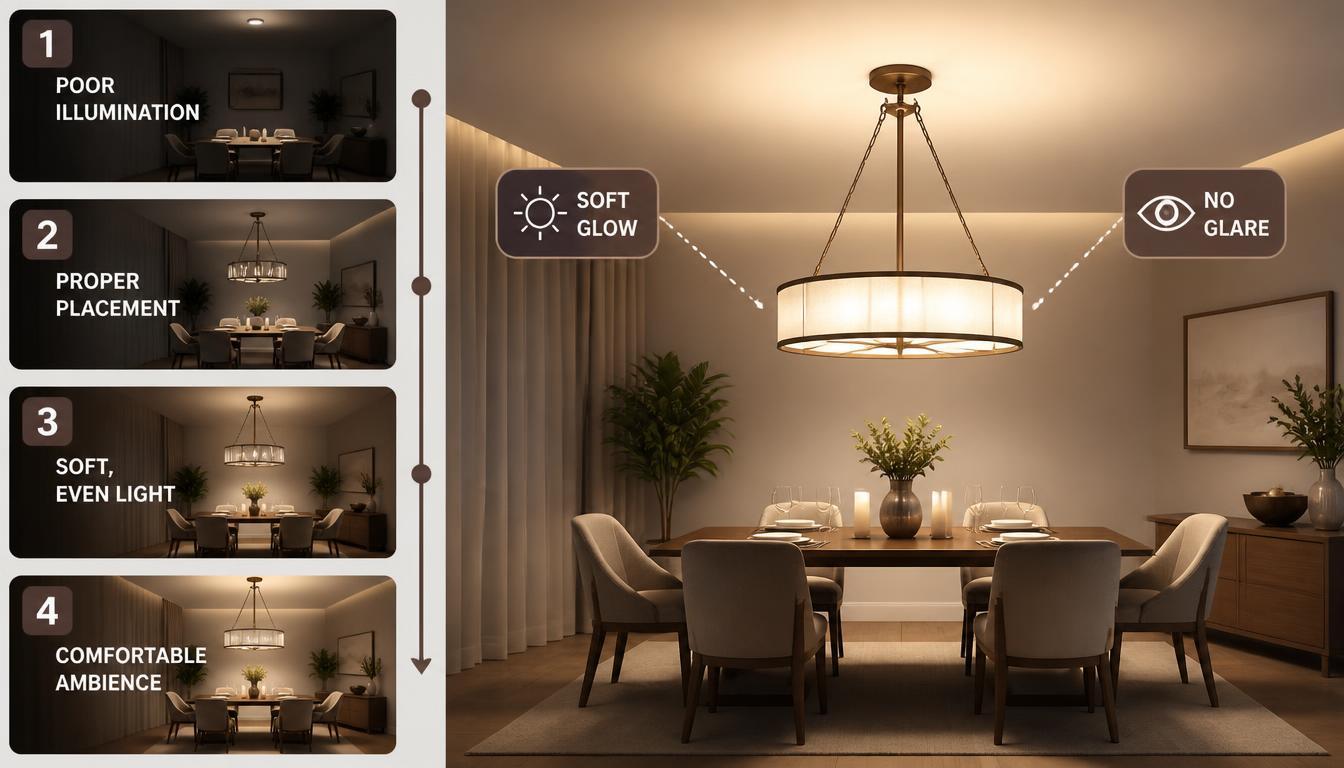
Poor lighting conditions can hamper the ability to see food, read the menu, or converse comfortably with those seated at the table. The right dining room chandeliers provide adequate illumination in this scenario. Other design concepts like dimming and diffusion may act as sound techniques in reducing the burden of excessive brightness.
Why Do Dining Room Chandeliers Increase Visibility At Tables?
The first advantage is focused illumination. With well-positioned lighting, light is brought closer to the table, hence reducing the gap between the source and the task surface.
This makes it possible to see plates, glasses, and the menu without having to use overly bright light from the top of the ceiling. According to IES, overhead lighting may aid in providing sufficient lighting when the beam is directed correctly.
Dining room lighting should work with other ambient lighting sources in the room.
Where To Install Chandelier Above The Dining Table?
Position is important. It has to coincide with the position of the dining table and not the middle of the room, if it coincides with it.
Linear dining room chandeliers work best for long tables. For round or square tables, a deluxe pendant light or a small chandelier can be used.
Sufficient space must be left between the light fixture and the table to ensure maximum visibility. The specific height of installation depends on the specifics of the fixture’s size, height of the ceiling, and dimensions of the tabletop.
Before final installation, sit in a few different spots around the table.
How Can The Fixture Reduce Harsh Glare?
Brightness alone does not solve poor visibility. Excessively bright sources can create strong contrast and uncomfortable viewing conditions.
A diffuser can soften the visible source, while broader distribution can spread light across the tabletop. DOE explains that bright sources can contribute to discomfort glare, while indirect lighting can create broader areas of moderate brightness.
Table illumination should therefore remain strong enough for the intended task without making the luminous source the visual focus.
Dimming adds another layer of control. Lower output can suit relaxed evening meals, while higher output can support reading menus or serving food.
Which Chandelier Type Fits The Table?
The fixture should match the table shape and the way light needs to spread.
|
Chandelier Type |
Suitable Table |
Main Lighting Approach |
What To Consider |
|
Linear |
Long rectangular |
Broad distribution along the table |
Match fixture length to table |
|
Multi-light |
Large rectangular or oval |
Several points across the surface |
Balance spacing between lights |
|
Drum shade |
Round or rectangular |
Diffused downward light |
Check shade opacity |
|
Open-frame |
Various shapes |
Direct and decorative output |
Control visible lamp brightness |
IES research on restaurant lighting found that centering an overhead light over the table can help illuminate the table while managing contrast. This principle can also inform residential dining layouts.
How Does The Chandelier Accommodate Other Lights In The Room?
Chandelier lighting should complement other types of lighting and not be the only ones that light a room.
It is required to assess the effects of the lighting on a dining table, walls and other objects located in the room.
Down lighting will help highlight the dining space, while diffused lighting will allow for eliminating any contrasts between the dining table and other spaces in the room.
The chandelier may also need to fit the overall interior design; in terms of style, size, texture, and colors used.
Circ Lighting can help achieve this compatibility for your chandelier light fixture.
How Does Placement Support Comfortable Lighting?
Glare reduction starts with the viewing angle. A fixture that looks comfortable from one chair may appear too bright from another.
Test the chandelier from seated positions before permanent installation. Look for exposed lamps, sharp reflections on glassware, and bright areas within normal lines of sight.
Dimming, diffusion, and appropriate mounting can then reduce those problems without sacrificing useful table light.
Conclusion
A chandelier is most effective when its light is distributed evenly across the table while remaining comfortable from different seating positions. Dining room chandeliers can be used to address the issue of poorly lit dining tables through proper placement, regulation, and diffusion of light. The right fixture should support the meal rather than compete with it.

 Arabic
 French
 Spanish
 Portuguese
 Deutsch
 Turkish
 Dutch
Dutch
 Italiano
 Russian
 Romaian
 Portuguese (Brazil)
 Greek
Greek