


Azure vs AWS Security: A Complete Cloud Security Comparison for 2026
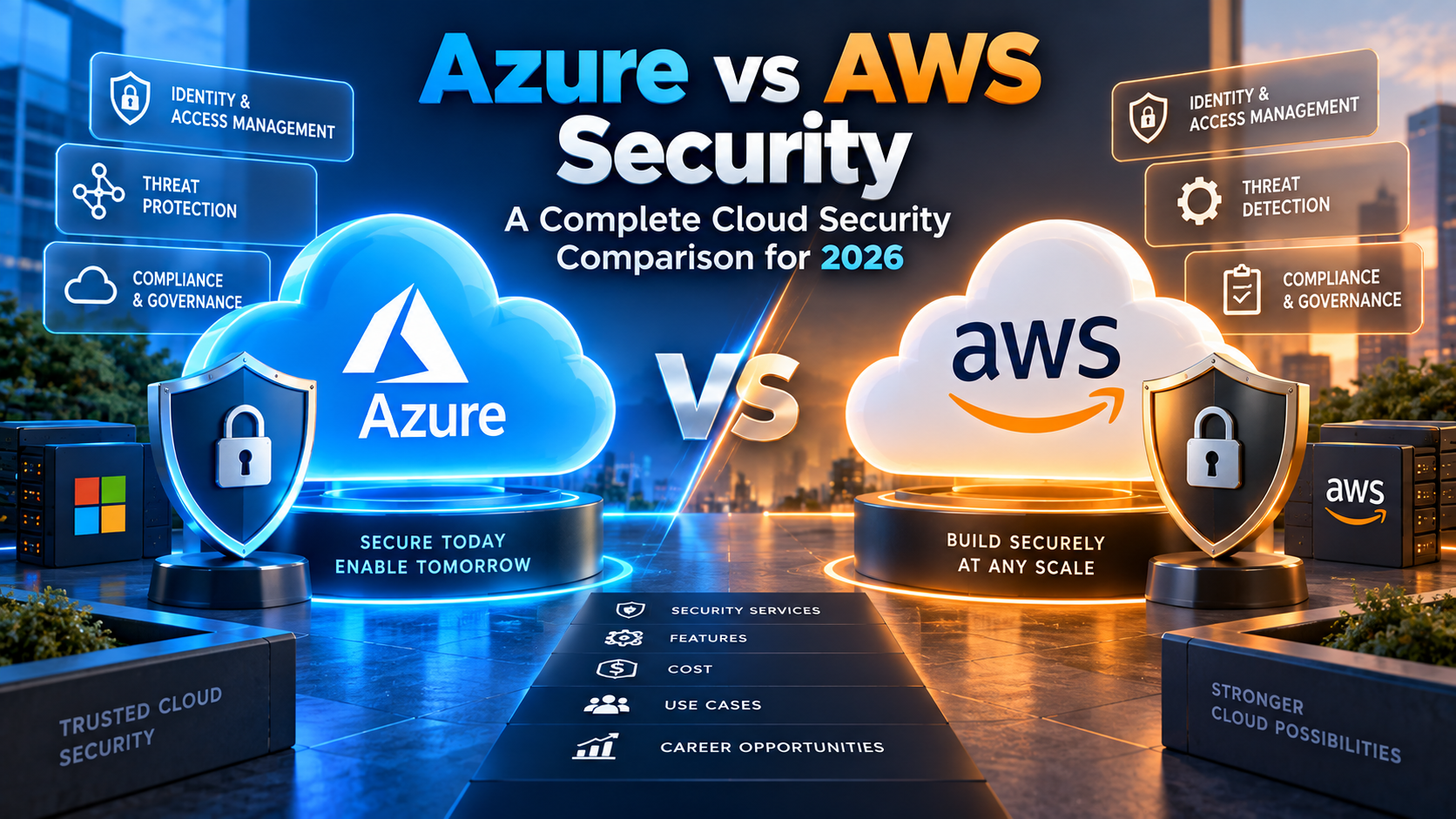
Microsoft Azure and Amazon Web Services both provide mature cloud security ecosystems in 2026. Each platform includes identity management, encryption, threat detection, security posture management, network protection, compliance monitoring, and centralized security operations.
The main difference is not that one cloud is secure and the other is not. The difference is how their security services are organized, integrated, and operated.
A simple comparison is:
Azure security is especially strong for organizations built around Microsoft identity, Microsoft 365, hybrid infrastructure, and Defender security products.
AWS security is especially strong for AWS-native workloads, granular IAM policies, account-based architectures, and deeply integrated infrastructure security services.
The right platform depends on your existing environment, workloads, team expertise, and security architecture.
Azure vs AWS Security at a Glance
|
Security Area |
Microsoft Azure |
AWS |
|
Identity |
Microsoft Entra ID |
AWS IAM |
|
Key Management |
Azure Key Vault |
AWS KMS |
|
Security Posture |
Microsoft Defender for Cloud |
Security Hub CSPM |
|
Threat Detection |
Defender for Cloud |
Amazon GuardDuty |
|
SIEM/SOAR |
Microsoft Sentinel |
Security Hub plus integrated security services |
|
Network Security |
Azure Firewall, NSGs, WAF |
Security Groups, NACLs, AWS WAF |
|
Secrets |
Azure Key Vault |
AWS Secrets Manager |
|
Cloud Compliance |
Defender for Cloud |
Security Hub CSPM |
|
Best Fit |
Microsoft and hybrid environments |
AWS-native cloud environments |
1. Identity and Access Management
Identity is one of the most important cloud security controls.
Azure Identity Security
Azure primarily uses Microsoft Entra ID for authentication and identity management.
Organizations can use it for:
-
Users and groups
-
Role-based access
-
Multifactor authentication
-
Conditional Access
-
Privileged identity management
-
Enterprise application access
Azure becomes particularly attractive when organizations already use Microsoft 365 or other Microsoft enterprise services because identity can extend across cloud and workplace environments.
AWS Identity Security
AWS relies heavily on AWS Identity and Access Management (IAM).
IAM allows administrators to define detailed JSON-based policies controlling:
-
Who can access resources
-
Which actions are permitted
-
Which resources can be accessed
-
Under what conditions access is allowed
AWS also supports temporary credentials, roles, policy conditions, and attribute-based access-control patterns.
Key Difference
Azure is particularly strong when enterprise identity is centralized around Microsoft Entra.
AWS offers very granular AWS-resource permission management through IAM.
2. Security Posture Management
Cloud security teams need visibility into misconfigurations and policy violations.
Microsoft Defender for Cloud
Defender for Cloud provides:
-
Cloud Security Posture Management
-
Workload protection
-
Threat detection
-
Compliance monitoring
-
Security recommendations
It can also assess environments beyond Azure, including AWS and Google Cloud resources. Microsoft’s cloud security benchmark can be applied across Azure and supported multicloud environments.
AWS Security Hub CSPM
AWS Security Hub CSPM evaluates cloud environments against security standards and recommended configurations.
It can aggregate findings and work with services such as:
-
GuardDuty
-
Amazon Inspector
-
Amazon Macie
AWS recommends integrating these services to gain broader security visibility.
Key Difference
Defender for Cloud has a particularly strong multicloud and hybrid-security orientation.
Security Hub CSPM is deeply integrated with AWS-native infrastructure and security services.
3. Threat Detection
Azure
Azure threat detection is built around services including:
-
Microsoft Defender for Cloud
-
Microsoft Defender XDR
-
Entra ID Protection
-
Microsoft Sentinel
Defender for Cloud provides workload protection and threat detection, while Sentinel adds SIEM and SOAR capabilities such as analytics, threat intelligence, UEBA, and automation.
AWS
AWS commonly uses Amazon GuardDuty for threat detection.
GuardDuty can identify suspicious or unauthorized activity and integrates with other AWS security services. AWS recommends enabling it across supported Regions for broader monitoring coverage.
Key Difference
Azure's security ecosystem connects particularly well with broader Microsoft security operations.
AWS provides highly integrated threat detection for AWS workloads through GuardDuty and related services.
4. SIEM and Security Operations
Azure has a clear advantage for organizations already centered around the Microsoft security operations ecosystem.
Microsoft Sentinel
Sentinel provides:
-
SIEM
-
SOAR
-
Threat intelligence
-
Automated playbooks
-
Behavioral analytics
-
Centralized investigations
It can ingest security data from cloud, hybrid, and third-party environments.
AWS security operations commonly combine multiple services rather than relying on one directly equivalent product.
Security Hub centralizes and prioritizes findings, while GuardDuty, Inspector, and related services provide detection and security information.
5. Encryption and Secrets Management
Both platforms provide strong encryption services.
Azure
Azure uses tools such as:
-
Azure Key Vault
-
Managed identities
-
Encryption at rest
-
TLS for data in transit
Key Vault stores:
-
Keys
-
Secrets
-
Certificates
It also integrates with Microsoft Defender for Cloud for security recommendations and alerts.
AWS
AWS provides:
-
AWS Key Management Service
-
AWS Secrets Manager
-
Certificate Manager
-
Service-specific encryption controls
AWS security certification objectives also explicitly include implementing encryption and data-protection mechanisms.
Both ecosystems can support enterprise-grade cryptographic controls when configured correctly.
6. Network Security
Cloud network security is another area where both platforms offer similar capabilities under different product names.
Azure
Common services include:
-
Network Security Groups
-
Azure Firewall
-
Web Application Firewall
-
Private endpoints
-
DDoS protection
AWS
Common options include:
-
Security Groups
-
Network ACLs
-
AWS WAF
-
AWS Shield
-
PrivateLink
AWS applies the shared responsibility model to services such as WAF, meaning AWS secures the underlying cloud infrastructure while customers remain responsible for configuring and securing their workloads appropriately.
The most important factor is therefore not simply which firewall product exists, but how correctly security policies are designed.
7. Shared Responsibility
Both Azure and AWS operate under cloud shared-responsibility principles.
The provider protects the underlying cloud platform, while customers remain responsible for areas that vary according to the service being used.
On AWS, responsibilities can include:
-
IAM configuration
-
Data protection
-
Application security
-
Workload configuration
-
Security controls
AWS explicitly describes this distinction as security of the cloud versus security in the cloud.
Azure follows a similar cloud-security model, with responsibility varying across infrastructure, platform, and managed services.
8. Compliance and Governance
Both platforms provide tools to monitor compliance against security standards.
Azure
Defender for Cloud supports compliance monitoring and security benchmarks across Azure and supported multicloud environments.
AWS
Security Hub CSPM evaluates AWS environments against security standards and best practices and aggregates related findings.
Organizations subject to regulated requirements should still validate the specific services, regions, configurations, and compliance programs relevant to their industry.
9. Multicloud Security
This is an increasingly important difference.
Microsoft Defender for Cloud can assess:
-
Azure
-
AWS
-
Google Cloud
from a broader security posture perspective.
That can make Azure's security ecosystem attractive to enterprises running multiple cloud providers.
AWS security tools remain particularly optimized for workloads already inside AWS.
If your organization is primarily AWS-based, that deep native integration may be preferable.
10. Azure vs AWS Security Certifications
Professionals can also choose between different certification paths.
Microsoft Security
Microsoft currently offers Cloud and AI Security Engineer Associate, associated with exam SC-500.
It covers:
-
Identity
-
Azure Key Vault
-
Compute security
-
Storage security
-
Networking
-
Compliance
-
AI workload security
-
Security posture management
Microsoft introduced SC-500 as the successor direction after AZ-500 retired on August 31, 2026.
AWS Security
AWS currently offers AWS Certified Security – Specialty (SCS-C03).
Its domains cover:
-
Detection
-
Incident response
-
Infrastructure security
-
Identity and access management
-
Data protection
-
Security foundations and governance
The two paths reflect the underlying platform differences.
Which Security Path Should You Learn?
If you already work in a Microsoft environment, Azure security may offer the more natural path.
For professionals comparing both ecosystems, Cert Empire provides an AWS vs Azure certification comparison that can complement hands-on labs, current certification objectives, and practical cloud-security study.
Choose Azure Security If You Work With:
-
Microsoft Entra
-
Microsoft 365
-
Azure infrastructure
-
Defender
-
Sentinel
-
Hybrid Microsoft environments
Choose AWS Security If You Work With:
-
AWS IAM
-
EC2
-
S3
-
VPC
-
GuardDuty
-
Security Hub
-
AWS-native architectures
Which Platform Is Easier for Security Beginners?
The easier option usually depends on what you already know.
Azure can feel easier if you have experience with:
-
Microsoft 365
-
Windows administration
-
Entra ID
-
Azure
AWS may feel easier if you already understand:
-
IAM
-
Linux
-
AWS networking
-
AWS infrastructure
For complete beginners, learn cloud fundamentals first before attempting advanced security certification.
Azure vs AWS Security for Enterprises
Azure can be especially attractive to organizations with significant Microsoft infrastructure because identity, endpoint, cloud, SIEM, and productivity security can operate within a closely connected ecosystem.
AWS can be especially attractive for organizations operating large AWS-native architectures that require granular IAM, strong account separation, and deep integration between AWS security services.
Neither eliminates the need for skilled security architecture.
Poorly configured IAM, exposed resources, excessive permissions, or weak monitoring can create risks on either platform.
Final Verdict
Azure and AWS both provide comprehensive cloud-security capabilities in 2026.
Azure security stands out for:
-
Microsoft identity integration
-
Hybrid security
-
Microsoft Defender
-
Sentinel
-
Multicloud posture management
AWS security stands out for:
-
Granular IAM
-
AWS-native security integration
-
GuardDuty
-
Security Hub
-
Infrastructure-focused security controls
Your best choice should depend on where your workloads, identities, and business systems already operate.
Conclusion
The Azure vs AWS security debate should not be reduced to which provider is "more secure."
Both platforms provide the controls required to build highly secure cloud environments.
The real difference is how those controls fit your architecture.
Azure is particularly compelling for Microsoft-heavy, hybrid, and multicloud organizations.
AWS is particularly compelling for AWS-native workloads requiring deep integration with IAM, GuardDuty, Security Hub, and other AWS security services.
For cloud-security professionals, learning either platform can provide valuable skills. Eventually understanding both can be useful for multicloud environments, but developing strong security depth in one platform first is usually the more practical approach.
FAQs
Is Azure more secure than AWS?
Neither platform is inherently secure simply by being selected. Both provide extensive security controls, while customers remain responsible for configuring identities, workloads, permissions, data, and applications correctly.
What is the Azure equivalent of AWS IAM?
Microsoft Entra ID and Azure role-based access control provide many of the identity and authorization capabilities used to secure Azure environments.
What is the AWS alternative to Defender for Cloud?
AWS Security Hub CSPM, GuardDuty, Inspector, and related services collectively cover many posture-management, vulnerability, and threat-detection functions.
Which cloud is better for multicloud security?
Microsoft Defender for Cloud directly supports security-posture assessment across Azure, AWS, and Google Cloud, making it particularly relevant to multicloud operations.
Which certification is best for Azure security in 2026?
Microsoft's Cloud and AI Security Engineer Associate, associated with SC-500, is the current role-based security-engineering certification covering Azure, hybrid, and AI-enabled environments.
Which AWS certification focuses on security?
AWS Certified Security – Specialty (SCS-C03) validates advanced skills across detection, incident response, infrastructure security, IAM, data protection, and governance.
Read More: Anthropic CCAR-P Exam 2026: Exam Format, Topics, Cost, and Preparation Guide

 English
 Arabic
 French
 Spanish
 Portuguese
 Deutsch
 Turkish
 Dutch
Dutch
 Italiano
 Russian
 Portuguese (Brazil)
 Greek
Greek