


What Is the Best Fireproof Safe for Documents?
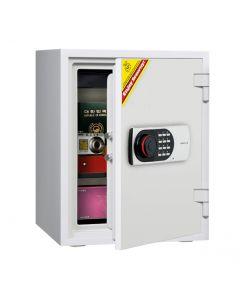
Passports, birth certificates, wills, property titles, insurance policies, tax records and business contracts are painful and time-consuming to replace, and some cannot be replaced at all. A house fire can destroy all of them in minutes, which is why a fireproof document safe is one of the most practical purchases a household or small business can make.
There is no single "best" safe for everyone, though. The right choice depends on what you are storing, where the safe will sit and how much protection you need. This guide explains what to look for so you can choose with confidence.
First, Understand What "Fireproof" Really Means
No safe is truly fireproof. The correct term is fire-resistant, meaning the safe can keep its internal temperature below a certain level for a stated period while exposed to extreme heat.
This matters because paper starts to char at around 175°C and ignites at higher temperatures. A good document safe is designed to keep the inside below that threshold, even when the fire outside is far hotter. Its insulation, door seals and wall construction all work together to slow the heat transfer.
When comparing models, look for two key details:
- Temperature: the external heat the safe was tested against.
- Duration: how long the safe held its interior within safe limits, often 30, 60 or 120 minutes.
If a product only says "fireproof" with no test details, treat it with caution.
Check the Fire Rating
Fire ratings are the most important feature of any document safe. They come from independent testing against recognised standards, and they tell you what the safe has actually proven it can survive. You can learn more about how these work on the cash and fire ratings page.
A few points to keep in mind:
- Look for independent certification. A rating from a recognised testing body is far more reliable than a manufacturer's own claim.
- Choose an appropriate duration. A 30-minute rating may suit a typical home in an area with quick emergency response, while a 60 or 120-minute rating gives a stronger safety margin for larger houses, rural properties or irreplaceable records.
- Remember that fire ratings and theft ratings are separate. A safe that resists fire does not necessarily resist burglary. If you also need to protect cash or valuables, check both ratings.
Think About What You Are Storing
Not all items react to heat in the same way, and this affects which safe is best.
Paper documents. Passports, certificates, wills, deeds and contracts are the classic use for a fire-resistant document safe. Standard fire protection is designed around paper.
Digital media. USB drives, external hard drives, memory cards, CDs and DVDs are far more sensitive to heat and humidity than paper. They can be damaged at much lower temperatures than the point where paper chars. If you store backups or digital copies, look for a safe with specific media-rated protection, or choose a model with an internal media chest designed for these items.
Valuables and cash. If you want to keep jewellery, cash or other valuables alongside your documents, you will need stronger anti-theft construction as well as a good fire rating.
Many households are best served by keeping original documents in a fire-resistant safe and a digital backup in a media-rated container or stored offsite.
Consider Size and Capacity
It is easy to underestimate how much space you need. A safe that holds your passport and a few certificates today may feel cramped within a year.
Think about the size of your documents too. Standard A4 folders, lever-arch files and legal-size papers all need different internal dimensions. Check the internal measurements rather than the external ones, since thick fire-resistant walls take up a lot of space.
As a rule of thumb, choose a safe that is slightly larger than your current needs. People nearly always store more over time, and a safe that is crammed full is harder to use.
Weight and Anchoring
Fire-resistant safes are often heavy because of their insulation, which can make them harder to move. That weight helps protect against theft, but lighter and smaller models can still be picked up and carried away.
If your safe is small or lightweight, bolt it to the floor or a wall. Correct anchoring also keeps the safe in position if the building is damaged during a fire. A safe that falls through a weakened floor can be damaged or have its seals compromised.
For heavy models, professional delivery and installation is worth considering. It ensures the safe is moved safely, positioned correctly and anchored to suit your floor and wall type.
Choose a Locking Mechanism You Will Actually Use
A safe that is annoying to open tends to be left open, which defeats its purpose. Match the lock to how often you will access it.
- Key lock: simple and reliable, but keys can be lost, copied or hard to find in an emergency.
- Electronic keypad: quick to use and allows code changes, though it relies on batteries.
- Biometric: fast fingerprint access that suits frequent use. Quality varies, so choose a reputable model. See the range of biometric safes for options.
- Mechanical combination dial: durable and needs no power, but slower to operate.
For documents that you only need occasionally, a key or mechanical lock is often enough. For items you reach for regularly, an electronic or biometric lock is usually more convenient.
Look at Door Seals and Construction
Features that are easy to overlook can have a large effect on performance in a real fire.
Intumescent seals. Many quality fire safes have seals that expand when heated, closing the gaps around the door and blocking hot gases and smoke. This is one of the most important features of a good fire-resistant safe.
Wall thickness and insulation. Thicker, well-insulated walls slow heat transfer. This is one reason higher-rated safes tend to be heavier.
Door fit and hinges. A tight, well-engineered door keeps the heat out. Poorly fitted doors can warp under high temperatures.
Humidity control. After a fire, water from firefighting can also damage documents. Some safes include features that help limit moisture, and you can add a dehumidifier or silica gel to protect against everyday humidity.
Where to Place Your Safe
Placement affects both security and protection.
- Lower floors are generally better for fire resistance, since a safe on an upper floor may fall through during a fire.
- Choose a concealed spot such as a wardrobe, a cupboard, a study or a built-in recess.
- Avoid areas prone to flooding, such as low-lying basements, unless the safe is designed for it.
- Keep it away from obvious fire sources like kitchens and heaters where practical.
What About Insurance?
If you are insuring valuables, check what your insurer requires. Coverage limits are sometimes tied to the safe's rating, and the wrong safe may limit your claim. It is worth a quick call before you buy.
Common Mistakes to Avoid
- Buying on price alone. Cheap, unrated "fireproof" boxes may offer little real protection.
- Confusing fire boxes with safes. Lightweight fire boxes may slow heat briefly but are usually easy to carry away or pry open.
- Ignoring digital media. Standard paper protection may not be enough for drives and discs.
- Choosing a size that is too small. You will outgrow it quickly.
- Skipping anchoring. An unsecured safe can be removed or damaged.
- Forgetting to update contents. Review what you store each year and remove anything no longer needed.
So, Which Is the Best Option?
The best fireproof safe for documents is the one that:
- Carries an independent fire rating suited to your risk level
- Offers protection for your specific items, including media if needed
- Has enough internal space for current and future documents
- Uses a lock you will use comfortably
- Is correctly anchored in a sensible location
- Fits within your budget, without compromising on proven ratings
For most homes, a certified fire-resistant document safe with a 60-minute rating, intumescent door seals and a reliable lock is a strong starting point. Households with irreplaceable records, large collections of paperwork or digital backups may want a higher rating or a media-rated model. You can compare options in the fireproof document safes range.
Final Thoughts
You never know when you will need a fireproof safe, but when you do, it will be the one thing that makes recovery manageable instead of overwhelming. Take time to understand ratings, match the safe to what you store, and install it properly. A little care now can save you a great deal of stress, cost and heartache later.

 Arabic
 French
 Spanish
 Portuguese
 Deutsch
 Turkish
 Dutch
Dutch
 Italiano
 Russian
 Romaian
 Portuguese (Brazil)
 Greek
Greek