


How Custom Printed Display Boxes Improve Retail Product Presentation?
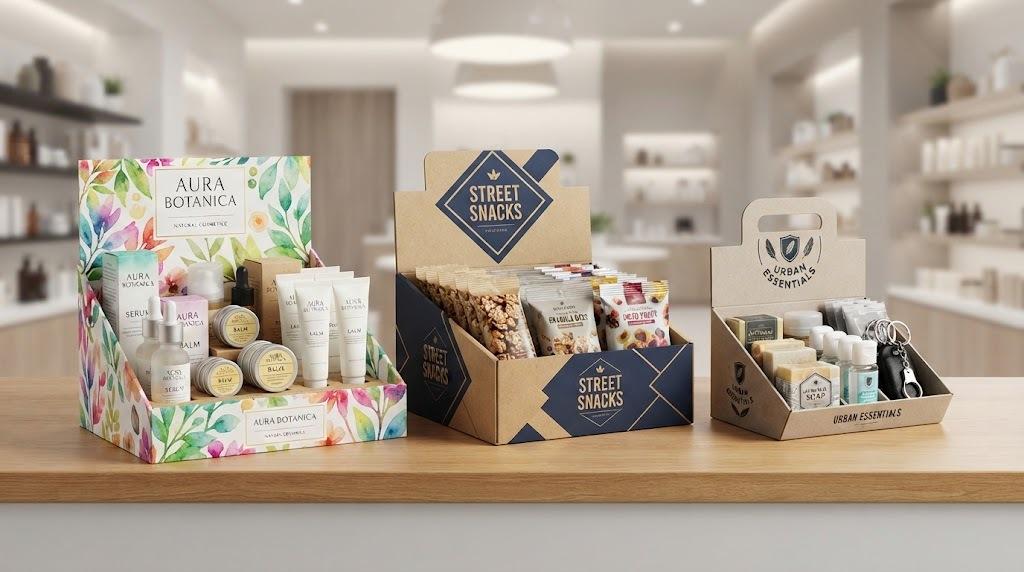
In a retail store, product presentation can influence what shoppers notice, explore, and eventually purchase. Even a useful product may go unnoticed when it is placed among dozens of competing items without clear organization or visual appeal. Custom printed display boxes help businesses present merchandise in a more structured and recognizable way. From countertop displays for small products to larger cardboard units for retail shelves, these packaging solutions combine product organization, brand communication, and convenient access. Their design can help retailers make better use of display space while creating a consistent shopping experience.
What Are Custom Printed Display Boxes?
Custom printed display boxes are packaging units designed to hold and showcase products in retail environments. Unlike conventional packaging intended primarily for storage or transportation, these boxes are created to keep products visible and accessible to shoppers.
They may be placed on checkout counters, retail shelves, promotional tables, endcaps, or dedicated product display areas. Businesses can customize their dimensions, structure, colors, graphics, and printed messaging to suit the products they sell.
For example, a cosmetics brand might use a countertop display for lip balms, while a food business could use a shelf-ready display for individually packaged snacks. The structure should support the products securely while making them easy to identify and remove.
How Custom Printed Display Boxes Improve Retail Product Presentation
Retail display packaging does more than hold merchandise. Its structure, printing, and placement can help businesses organize products and communicate important information at the point of sale.
1. Make Products More Noticeable on Retail Shelves
Retail stores often carry products from multiple brands within the same category. A product placed directly on a crowded shelf may have limited space to communicate its identity. A dedicated display box can give it a more organized and distinctive presentation.
Businesses can use contrasting colors, clear product names, recognizable logos, and relevant graphics to make displays easier to identify. For instance, a snack brand may use a brightly printed counter display to distinguish individual snack packs from surrounding products.
However, visibility depends on more than color alone. The display's height, placement, lighting, and surrounding merchandise also influence how easily customers notice it.
2. Strengthen Brand Identity Through Custom Printing
Consistent branding helps shoppers recognize products across different retail locations. Printed cardboard display boxes provide space for business logos, brand colors, product names, taglines, and other visual elements.
A skincare company, for example, might use neutral colors, minimal graphics, and a clean layout to reflect its brand identity. A children's toy company may prefer colorful illustrations and larger product images.
When the same visual identity appears on the display, individual packages, and promotional materials, the overall presentation becomes more cohesive. Businesses should keep the design readable and avoid overcrowding the available printing area with too much information.
3. Organize Products for Easier Shopping
A well-designed display helps retailers arrange products neatly instead of placing loose packages directly on a counter or shelf. Organized merchandise can be easier to browse, compare, and replenish.
Display boxes may include multiple compartments, tiered sections, or dividers to separate different product varieties. A cosmetics display could arrange lip glosses by shade, while a confectionery display might separate flavors into individual rows.
The structure should correspond to the number, size, and shape of the products. Compartments that are too narrow can make items difficult to remove, while oversized sections may allow products to shift or become disorganized.
4. Communicate Product Information at the Point of Sale
Shoppers often want to understand a product quickly before deciding whether to examine it more closely. Printed displays can provide concise information that supports this decision.
Useful details may include:
-
Product names and descriptions.
-
Available flavors, colors, or variations.
-
Key features and benefits.
-
Promotional messages and seasonal offers.
-
QR codes linking to additional product information, where appropriate.
For example, a display for packaged herbal tea could identify the different flavors and briefly explain their characteristics. A small heading or clear label can help shoppers understand what the display contains without requiring them to inspect every package individually.
Information should remain accurate, easy to read, and relevant to the purchasing decision.
5. Encourage Product Discovery and Impulse Purchases
Checkout counters, service desks, and high-traffic promotional areas provide opportunities to introduce customers to smaller products. Display packaging can make these items easier to see and access while customers browse or wait to pay.
Products such as chewing gum, travel-size toiletries, lip balms, small accessories, and individually wrapped treats may suit compact counter displays.
The display should make the products visible without blocking access or interfering with the shopping area. Although attractive presentation can encourage product exploration, purchases also depend on price, product relevance, availability, and customer preferences.
6. Create a Consistent Retail Presentation
Businesses selling through several stores may need their merchandise to look similar across different locations. Custom display packaging can provide a repeatable layout for product placement, branding, and promotional messaging.
Retail teams can use the same display dimensions and artwork across branches, adjusting the quantity or product arrangement when necessary. This helps maintain a consistent appearance even when store layouts differ.
For seasonal promotions, businesses can also introduce updated graphics while keeping the basic display structure unchanged. This allows the packaging to reflect a particular campaign without requiring a completely different presentation system every time.
7. Make Better Use of Limited Retail Space
Retail space is valuable, especially in convenience stores, pharmacies, small boutiques, and checkout areas. A display box designed for a specific product range can help businesses use available space more efficiently.
Countertop displays are suitable for compact merchandise, while tiered or vertical designs can present multiple products within a relatively small footprint. Shelf-ready displays may also allow staff to place a group of products on a shelf without unpacking every unit individually, depending on the design.
Before selecting a structure, retailers should measure the available area and consider neighboring products, customer reach, restocking access, and store requirements. A display that is too large can obstruct other merchandise rather than improve the shopping experience.
Types of Custom Printed Display Boxes for Retail
Different retail products require different display structures. The most suitable option depends on the product's weight, dimensions, packaging, and intended location.
|
Display box type |
Common retail uses |
Presentation advantage |
|
Countertop display boxes |
Cosmetics, snacks, small accessories, and travel-size products |
Keeps compact merchandise accessible near checkout counters |
|
Cardboard counter display boxes |
Candy, promotional items, and lightweight packaged products |
Provides a dedicated space for small product collections |
|
Shelf-ready display boxes |
Packaged foods, household products, and retail merchandise |
Helps group products for shelf placement and restocking |
|
Floor display boxes |
Snacks, seasonal merchandise, and promotional product ranges |
Creates a larger display area for high-volume product collections |
|
Tiered display boxes |
Cosmetics, small bottles, and accessories |
Makes products in different rows easier to see |
|
Dump bins and open-top displays |
Packaged snacks, lightweight accessories, and promotional items |
Allows customers to browse multiple products quickly |
Not every product needs a large display. Small items may benefit from a compact countertop structure, whereas heavier or larger products may require stronger materials and a more stable design.
How to Design Display Boxes That Present Products Effectively?
Good display packaging begins with a clear understanding of the merchandise and the retail environment. Businesses should consider several design elements before approving a production run.
Choose the Right Structure and Dimensions
Start by measuring the packaged products, including their height, width, and depth. Determine how many units should fit in each row and how customers will remove them.
A display for small cosmetic tubes may need individual slots, while a display for snack packets may work better with an open-front tray. The front panel should not hide the products, and the overall height should suit the intended shelf or counter.
For heavier merchandise, consider the load-bearing capacity of the base, dividers, and back panel. A sample or prototype can help reveal structural problems before mass production.
Select Suitable Materials
Cardboard and paperboard are common choices for retail display packaging because they can be cut, folded, and printed in various shapes. The appropriate grade depends on product weight, display size, expected handling, and how long the display will remain in use.
Lighter paperboard may suit small products on a countertop. Larger displays or units holding heavier merchandise may need stronger corrugated board or reinforced construction.
Material selection should also account for moisture exposure, transportation, and the possibility of repeated restocking. The strongest option is not always necessary; the goal is to select a structure that provides adequate support without unnecessary material or expense.
Use Printing and Finishing Strategically
Printed graphics should help shoppers understand the product and recognize the brand. Businesses can use full-color printing, product photography, illustrations, bold headings, and coordinated brand colors to create a unified appearance.
Finishing options may include matte or gloss coatings, depending on the desired look and practical requirements. A matte surface may suit a restrained design, while a glossy finish can create a brighter appearance.
Choose finishes that complement the artwork instead of adding decorative elements without a clear purpose. Important text and product information should remain legible under typical store lighting.
Make Products Easy to Reach and Restock
A display should be practical for both shoppers and retail employees. Open fronts, accessible compartments, and suitable product spacing can make merchandise easier to remove.
Retailers should also consider how staff will replenish the display when stock runs low. Some structures allow products to be added from the top, while others are loaded from the front or rear.
A design that looks attractive but makes restocking difficult may create extra work for store employees. Testing the display with actual products can help identify these issues before the packaging is produced in bulk.
Which Businesses Benefit from Custom Retail Display Packaging?
Custom display boxes can serve a wide range of retail industries, but the structure and messaging should reflect each product category.
Food and confectionery businesses: Snack packs, chocolate bars, candy, and other individually packaged foods can be arranged in countertop or shelf-ready displays. Food-contact requirements should be considered where the packaging directly contacts food.
Cosmetics and personal care brands: Displays for lip balms, makeup, skincare tubes, and small personal care products can organize different shades, types, or product lines in one place.
Electronics and accessories retailers: Lightweight accessories such as cables, adapters, and small packaged gadgets may benefit from organized compartments and clear product labeling.
Pharmacies and health retailers: Small packaged items can be grouped by category when the display complies with relevant labeling and merchandising requirements.
Gift and seasonal product businesses: Holiday merchandise, party favors, small gifts, and promotional products can use themed graphics and compact structures to create a more coordinated presentation.
Each application has different requirements. Retailers should account for product dimensions, applicable regulations, store policies, and the amount of information shoppers need.
What to Consider Before Ordering Custom Printed Display Boxes?
Before ordering display packaging in bulk, businesses should review the practical and financial details of the project.
-
Product fit: Confirm that every product variation fits comfortably within the display.
-
Structural strength: Check whether the board grade and construction can support the intended load.
-
Artwork approval: Review logo placement, colors, text, and printed dimensions before production.
-
Retail placement: Measure counters, shelves, endcaps, and other intended display areas.
-
Assembly requirements: Consider whether displays arrive flat-packed, require manual assembly, or can be placed directly on shelves.
-
Order quantity and budget: Compare setup costs, unit pricing, and expected sales volume.
-
Shipping and storage: Check how the displays will be transported and where unassembled units will be stored.
-
Replenishment: Make sure staff can add products without damaging the display or disrupting the arrangement.
If the design is new, requesting a prototype can help businesses evaluate its appearance and functionality with real merchandise. This is particularly useful for displays with unusual shapes, multiple compartments, or heavier products.
Conclusion
Custom printed display boxes help retailers present merchandise in a more organized, recognizable, and accessible way. With the right structure, materials, and artwork, businesses can improve product visibility, communicate useful information, reinforce brand identity, and make more efficient use of retail space. Using high-quality cardboard boxes for retail displays also provides a practical way to showcase products while maintaining a professional brand presentation.
The best design depends on the products being displayed and the environment in which customers will encounter them. By considering dimensions, printing, durability, placement, and restocking needs before ordering, businesses can develop effective display packaging that supports daily retail operations and creates a consistent customer experience.

 English
 Arabic
 French
 Spanish
 Portuguese
 Deutsch
 Turkish
 Dutch
Dutch
 Russian
 Romaian
 Portuguese (Brazil)
 Greek
Greek