


Electrosurgical Forceps Supply: Planning Orders Around Cosil’s Three-Week Dispatch Offer
A delivery plan needs more detail than a single lead-time figure.
Australian distributors must understand when production begins, when goods leave the supplier, and when they may arrive.
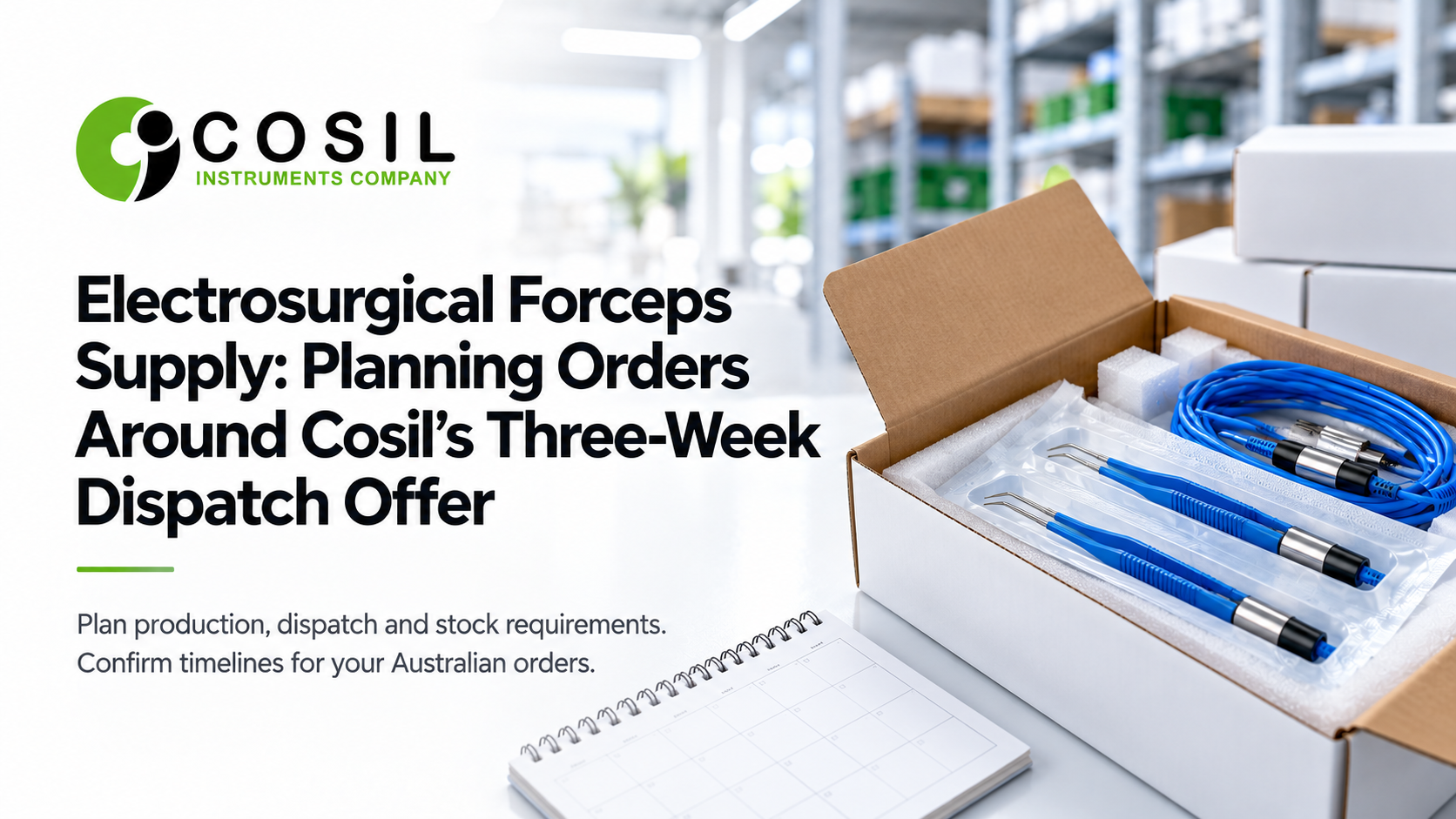
Cosil Instruments advertises three-week production and dispatch for its electrosurgical forceps-with-cable campaign.
The same promotion states monthly manufacturing capacity of 83,100 pieces. It also introduces a Distributor Support Program for potential Australian partners.
These figures provide a useful starting point for electrosurgical forceps supply discussions.
Before building an inventory plan, connect the advertised offer to your selected products and quantities. Confirm the order-specific schedule in writing.
Separate Production, Dispatch, and Arrival
Production time covers manufacturing activities within the agreed order process.
Dispatch refers to goods leaving the supplier through the agreed transport arrangement. Arrival depends on the remaining journey and receiving process.
These stages should not be combined into one promise.
|
Stage |
What your team needs to establish |
|
Order preparation |
Specifications and commercial details required |
|
Order acceptance |
Confirmation that the proposed order can proceed |
|
Production |
Agreed start point and manufacturing schedule |
|
Dispatch |
Handover date and transport arrangement |
|
Transit |
Carrier estimate for the selected route |
|
Receiving |
Your internal checks and stock-entry process |
The campaign’s three-week wording concerns production and dispatch. It should not be presented to customers as guaranteed arrival in Australia.
Confirm When the Three-Week Period Begins
A useful lead-time discussion starts with a defined starting point.
Ask whether the schedule begins after order acceptance, payment, specification approval, or another agreed condition.
Do not assume those events happen on the same day.
The enquiry should also establish what could change the schedule. A revised specification or incomplete order detail may require another review.
Ask the team to explain the conditions attached to the advertised timeframe.
Then record the agreed schedule alongside your quotation. This keeps purchasing and sales colleagues working from the same information.
Connect Capacity to Your Selected Products
The flyer states capacity of 83,100 pieces per month.
That is a company-advertised figure, not confirmation of free capacity for your order.
Ask how it relates to the product references you want. Clarify whether the figure covers a broader range or the particular campaign products.
Your discussion should include:
-
Proposed product references.
-
Quantities required for each reference.
-
Your preferred dispatch window.
-
Possible repeat-order frequency.
-
Any packaging requirements.
-
Expected changes in demand.
Avoid planning purchases from capacity alone. Available production allocation needs its own confirmation.
Build Forecasts That Separate Demand from Estimates
Your customers may provide firm requirements alongside less certain purchasing plans.
Keep those categories separate when preparing your enquiry.
A confirmed order can support a defined supply request. A forecast is useful for discussion but should remain clearly labelled.
For example, your business may expect gradual demand after adding a new product. Explain that situation rather than presenting projected sales as committed volume.
Share the assumptions behind your forecast.
These may include customer review stages, expected listing dates, and internal approval timelines. Clear context helps the supplier understand how your requirements could develop.
Review Transport Alongside Production
A product can be ready for dispatch before the transport arrangements are complete.
Ask who will coordinate collection or shipment and which information is required. Confirm the destination and receiving contact early.
Your team should also know what the quotation includes.
For shipping discussions, record:
-
The agreed delivery destination.
-
Transport arrangements under review.
-
Responsibilities for booking and coordination.
-
Documents requested for shipment.
-
Carrier timing when available.
-
Charges outside the product quotation.
Keep estimates distinct from confirmed bookings. Update customer communications when the transport details become clearer.
Prepare Your Internal Ordering Process
Supplier communication is only one part of the schedule.
Your company also needs time to review specifications, approve the purchase, and complete agreed payment steps.
Assign an owner to each internal action. A clear process reduces delays caused by missing decisions within your own team.
Cosil’s manufacturing and supply services provide a starting point for discussing the proposed order process.
Request confirmation of the terms relevant to this specific campaign. General website information may describe different products or ordering situations.
The written order agreement should guide your final planning.
Agree How Schedule Updates Will Be Shared
Ask who will communicate production progress and dispatch updates.
Confirm which changes require immediate attention from your company. Keep the commercial and logistics contacts visible to both teams.
A practical update record includes:
-
Current order status.
-
Information still needed.
-
The latest agreed dispatch date.
-
Transport details when confirmed.
-
Any change affecting your customer commitments.
Do not assume silence means the original schedule remains unchanged. Use an agreed follow-up point to resolve outstanding questions.
This helps your team communicate accurately without promising dates it cannot support.
Frequently Asked Questions
Does the campaign promise Australian delivery within three weeks?
No. It advertises production and dispatch in three weeks. International arrival timing needs separate confirmation.
Can my business reserve the stated monthly capacity?
The flyer does not state a reservation arrangement. Discuss availability and allocation for your proposed products directly.
What information helps confirm lead time?
Provide product references, quantities, specifications, packaging needs, and your destination. Ask which order conditions must be completed first.
Should I use the same timeline for every order?
No. Confirm the schedule for each relevant order, particularly when quantities or requirements change.
Discuss Your Next Supply Requirement
Send Cosil Instruments your product shortlist and expected quantities.
Email: sales@cosilinstruments.com
Mention the three-week campaign offer and ask whether it applies to your enquiry.
Request separate production, dispatch, and transit information. That gives your Australian distribution team a clearer basis for planning stock and customer commitments.

 English
 French
 Spanish
 Portuguese
 Deutsch
 Turkish
 Dutch
Dutch
 Italiano
 Russian
 Romaian
 Portuguese (Brazil)
 Greek
Greek