


Solar Can Support an RO Plant, but Only When the Water and Energy Schedules Agree
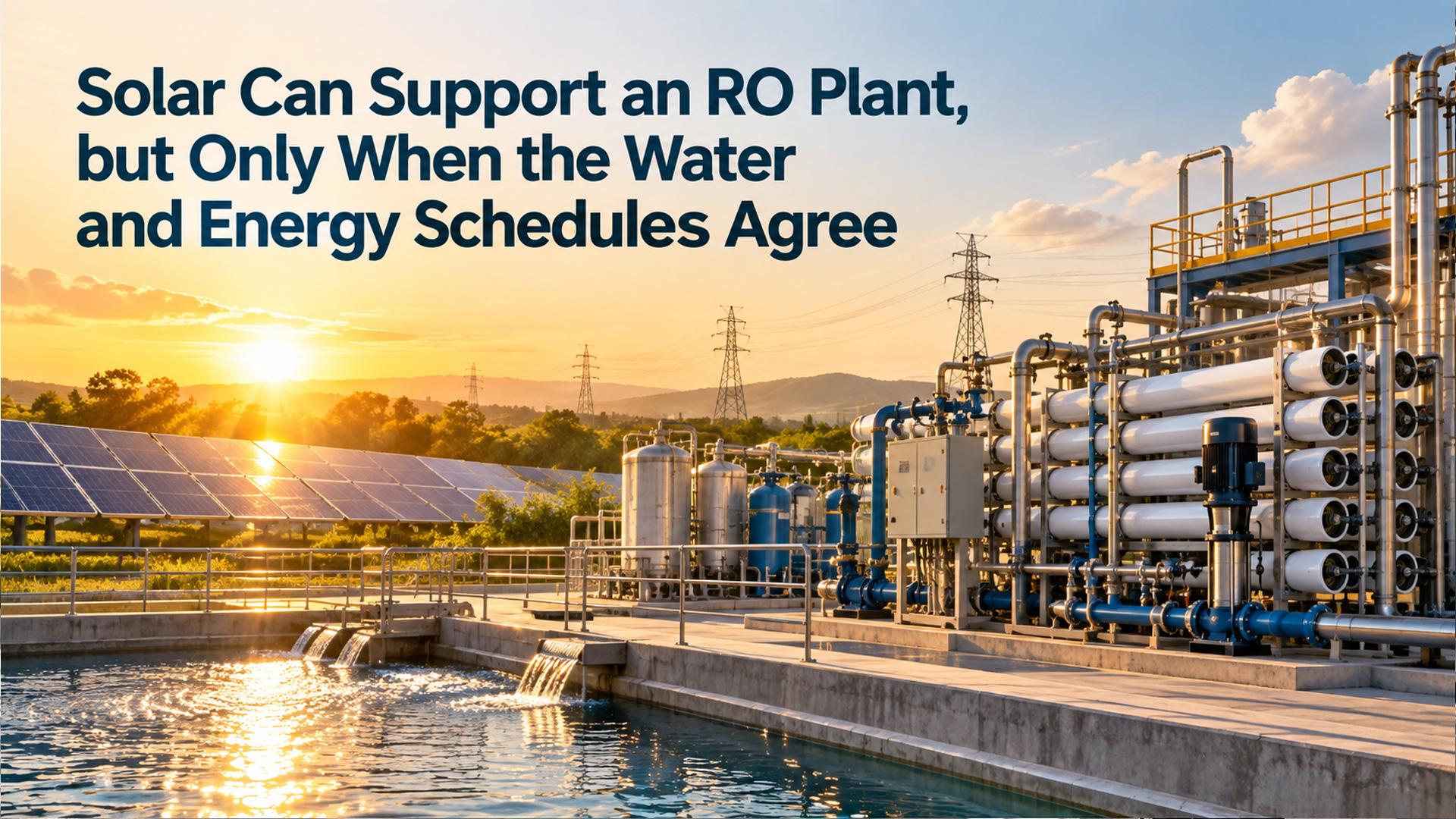
A successful solar-supported RO project starts by matching water demand, plant operating hours and electrical loads with the site's realistic solar-generation profile.
When solar and reverse osmosis are discussed together, one question usually comes first:
How many solar panels are needed to run the RO plant?
It sounds like the right starting point, but several more important questions need answers first.
How much treated water is required every day? How many hours can the RO plant operate? Is grid electricity available? Can treated water be stored? Which pumps and auxiliary systems run with the RO?
Once those inputs are understood, solar becomes part of a coherent engineering solution rather than a simple panel-count calculation.
An RO Plant Contains Several Electrical Loads
The high-pressure pump is often a major electrical load, but it is not necessarily the only one.
A complete system can also include:
-
Raw-water pumps
-
Pretreatment pumps
-
Chemical dosing
-
Instrumentation
-
Control panels
-
Backwash systems
-
Cleaning equipment
-
Product-water distribution pumps
A solar design should therefore consider the complete operating load rather than one motor rating.
Solar Generation and Water Demand Follow Different Schedules
An RO plant can be operated according to a defined production schedule.
Solar output changes through the day.
The project therefore has to decide whether the treatment plant should operate primarily during solar-generation hours or whether the wider electrical system should provide stable power while solar offsets part of the total demand.
Grid-Connected Solar Can Support the Wider Facility
Where grid power is available, solar generation does not necessarily need to be dedicated exclusively to the RO skid.
It can support the site's overall electrical demand while the treatment plant operates as one of several loads.
This can be particularly relevant for industrial facilities where water treatment, pumps, air conditioning, compressors and production machinery operate during daylight hours.
Treated-Water Storage Creates Valuable Flexibility
Water treatment has an operational advantage: the treated product can often be stored.
If demand continues after sunset, the RO plant may not need to run at exactly the same time that water is being consumed.
A suitable storage strategy can allow more production during favourable operating periods and supply later demand from the treated-water tank.
Water Storage and Battery Storage Are Not the Same Thing
Batteries store electrical energy.
Water tanks store the product of the treatment process.
Both can create operational flexibility, but they solve different problems.
A project should determine whether battery storage is actually required or whether part of the timing mismatch can be handled through treated-water storage.
Do Not Oversize the RO Plant Simply to Fit a Short Solar Window
Increasing RO capacity so the full day's water can be produced within fewer hours can appear attractive.
However, it can also increase:
-
Instantaneous electrical demand
-
High-pressure pump capacity
-
Membrane area
-
Pretreatment flow
-
Pipe sizing
-
Capital cost
The water and electrical systems should therefore be optimized together.
Feed-Water Quality Still Controls RO Design
Solar generation does not change the chemistry of the source water.
An RO system still needs to be selected around parameters such as:
-
TDS
-
Hardness
-
Turbidity
-
Silica where relevant
-
Iron where relevant
-
Microbiological conditions
-
Other source-specific contaminants
A poorly designed pretreatment system will not become more reliable simply because the electricity comes from solar energy.
Businesses evaluating the treatment side can review Water World International's industrial RO plant solutions for the broader commercial application.
RO Recovery Still Needs to Follow Water Chemistry
Higher recovery produces more permeate relative to the incoming feed, but the reject stream also becomes more concentrated.
Recovery should therefore remain compatible with:
-
Feed-water chemistry
-
Pretreatment
-
Membrane design
-
Scaling risk
-
Concentrate handling
An energy target should not override the basic membrane-treatment requirements.
Reject Water Still Requires a Management Plan
A solar-supported RO plant produces concentrate just like any other reverse-osmosis system.
The project should define:
-
Expected reject-water quantity
-
Approximate concentrate quality
-
Disposal or handling route
-
Whether further recovery is technically justified
Remote Projects Need a More Detailed Power Strategy
Solar-supported water treatment may be especially attractive where grid supply is limited or unreliable.
Remote projects should also define:
-
Required operating autonomy
-
Backup power
-
Battery requirements where applicable
-
Treated-water storage
-
Operator arrangements
-
Spare parts
-
Remote monitoring
The project needs a clear plan for periods when solar generation is insufficient.
Motor Starting Conditions Matter
Average energy consumption does not tell the complete electrical story.
Pumps and other motors can behave differently during starting compared with normal operation.
Inverters, protection systems and controls should be selected using actual equipment requirements.
Monitoring Should Connect Water Production and Energy Performance
A well-integrated plant can monitor:
-
RO water production
-
Operating pressure
-
Feed and permeate conductivity
-
Electrical consumption
-
Solar generation
-
Plant operating hours
-
Tank levels
-
System alarms
This helps operators determine whether a production problem is related to water treatment, electrical supply or changing demand.
Integrated Engineering Matters More Than Individual Equipment
A solar-supported RO project combines two engineering systems: water treatment and electrical generation.
Neither should be designed in isolation.
Water World International's Manufacturing and Engineering Services provides the broader route for projects that bring industrial utilities, water treatment and engineering requirements together.
Prepare the Right Information Before Requesting a Proposal
Useful project information includes:
-
Required treated water per day
-
Feed-water laboratory analysis
-
Required product-water quality
-
RO operating hours
-
Existing electrical supply
-
Current site electrical demand
-
Available solar area
-
Treated-water storage capacity
-
Backup-power requirements
-
Expected future expansion
Begin with the Requirement, Not the Panel Count
A good solar-supported RO project begins by understanding when water is needed and how the treatment plant consumes energy.
Solar may offset grid consumption, support daytime RO operation or form part of a hybrid power system. The right arrangement depends on the actual water and energy profile of the site.
Discuss a Solar-Supported Water Treatment Project
If your facility is considering solar integration with an industrial RO or other water-treatment system, prepare the water analysis, required production, operating schedule and available electrical information before requesting an engineering review.

 English
 Arabic
 French
 Portuguese
 Deutsch
 Turkish
 Dutch
Dutch
 Italiano
 Russian
 Romaian
 Portuguese (Brazil)
 Greek
Greek