


 About
 Terms
 Privacy
Electric Fence Market: Emerging Trends Transforming Modern Security Systems
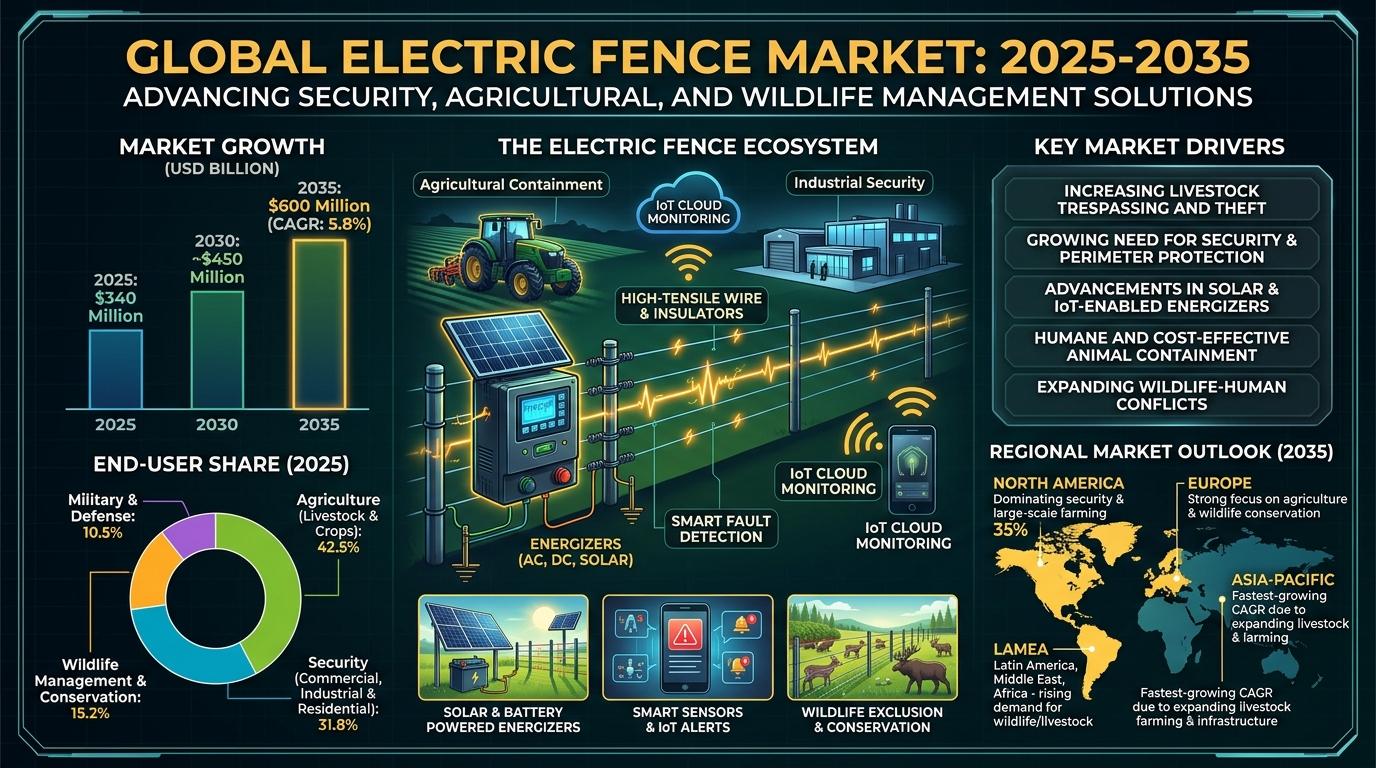
Security and property protection have become important considerations for agricultural businesses, residential property owners, commercial establishments, and industrial organizations. Traditional fencing continues to serve as a physical boundary, but organizations are increasingly exploring additional security solutions that can support perimeter monitoring and controlled access. Electric fencing is becoming an important option in this environment because it combines a physical boundary with an electrical deterrent.
The growing interest in electric perimeter security systems reflects the changing requirements of customers looking for adaptable solutions for property protection, livestock management, and restricted-area monitoring. Electric fencing is attracting attention because it can serve different purposes depending on the application, property layout, and operational requirements. Its versatility makes it relevant to several industries.
Understanding the Electric Fence Market
The electric fence market includes products and solutions designed to establish controlled boundaries using electrified fencing systems. These systems are used in agricultural environments, residential properties, commercial facilities, and industrial locations.
Unlike conventional fencing, electric fencing introduces an additional deterrent function. It can help discourage unwanted contact with protected boundaries while supporting animal containment and property management.
The market includes different product configurations designed for permanent and temporary applications. Portable solutions can be considered where fencing requirements change, while permanent systems are relevant to locations requiring established boundary protection.
The availability of different materials and power arrangements also allows customers to consider solutions that suit their operating environments.
Increasing Importance of Property Security
Property security is an important consideration for businesses and individuals managing valuable assets. Agricultural properties, warehouses, industrial facilities, and private establishments may require clearly defined boundaries and additional perimeter protection.
Electric fencing can form part of a broader security arrangement. Depending on the application, it may complement conventional fencing, access-control systems, surveillance cameras, and other security measures.
Organizations are increasingly interested in security solutions that can support their existing infrastructure rather than requiring an entirely separate security approach.
This creates opportunities for manufacturers to develop products that address different customer requirements and integrate with broader property protection strategies.
Agricultural Applications Supporting Demand
Agriculture remains an important application area for electric fencing. Farmers and livestock operators need suitable boundary systems to manage animal movement and protect agricultural property.
Electric fencing can support livestock containment and help establish controlled grazing areas. It can also be considered for protecting cultivated land from unwanted animal movement.
Different agricultural operations have different fencing requirements. Large farms may prioritize established boundary systems, while operators managing changing grazing areas may prefer portable solutions.
The availability of adaptable fencing products allows agricultural customers to evaluate options according to land conditions, livestock management practices, and operational preferences.
Technology and Product Innovation
Product innovation is influencing how manufacturers approach the electric fence market. Customers increasingly consider convenience, system reliability, monitoring capabilities, and compatibility with their existing property infrastructure.
Manufacturers can explore improvements in energizer technology, power management, monitoring features, and system components.
Solar-supported power arrangements may also appeal to customers managing properties where conventional electricity access is limited. Battery-powered and mains-powered configurations provide additional choices depending on site requirements.
The integration of monitoring technologies creates opportunities for customers to become more aware of system conditions and incorporate fencing into broader security management practices.
Commercial and Industrial Opportunities
Commercial and industrial establishments require security arrangements that reflect their property layouts and operational activities. Electric fencing may be considered for warehouses, storage facilities, industrial boundaries, and restricted locations.
Its role can extend beyond agricultural containment into broader perimeter management. Businesses may evaluate electric fencing as part of a layered security strategy that includes physical barriers, surveillance, and access-control arrangements.
The ability to serve different customer groups creates opportunities for manufacturers, distributors, installers, and security solution providers.
Challenges and Market Considerations
Despite its applications, the electric fence market faces several adoption considerations. Customers must evaluate local safety regulations, installation requirements, maintenance responsibilities, and environmental conditions.
The suitability of a particular solution depends on its intended application and the characteristics of the property. Buyers may also consider product quality, supplier support, compatibility, and long-term maintenance requirements.
Manufacturers must address these expectations while maintaining product reliability and customer confidence.
Future Outlook
The electric fence market is connected to changing requirements in agriculture, property protection, and commercial security. Increasing interest in adaptable fencing products and integrated monitoring solutions may encourage further product development.
As customers continue exploring different approaches to perimeter protection, manufacturers that prioritize reliability, application suitability, and customer support may find opportunities to strengthen their position in the industry.
Frequently Asked Questions
Q1. What is an electric fence used for?
Electric fences are used for livestock containment, agricultural boundary management, property protection, wildlife management, and selected commercial and industrial security applications.
Q2. What factors should customers consider when choosing an electric fence?
Customers should consider the intended application, property layout, environmental conditions, power availability, product reliability, applicable safety requirements, and maintenance support.
❤️ Support Friends Aim! View a sponsored ad to help cover our website costs. Thanks!
Support Us — Ad 1 Support Us — Ad 2- Arts, Culture & Design
- Automotive & Transport
- Accounting & Finance
- Advertising & Marketing
- Agriculture & Farming
- Business & Consulting
- Books & Publishing
- Building & Construction
- Beauty & Personal Care
- Baby, Kids & Parenting
- Charity & Social Causes
- Crafts & Handmade
- Careers & Jobs
- Computers & Laptops
- Consumer Electronics
- Entertainment & Events
- Food & Beverages
- Delivery & Logistics
- Digital Media & Content
- Dating & Relationships
- E-Commerce & Retail
- Education & Learning
- Energy & Environment
- Fitness
- Fashion & Apparel
- Gaming & Toys
- Government & Legal
- Gardening
- Health & Medical Care
- Home Decor & Furniture
- IT & Software
- Industrial & Tools
- Import & Export
- Jewelry & Watches
- Lifestyle & Wellness
- Legal Services & Law
- News & Media
- News & Current Affairs
- Religion & Faith
- Sports
- Technology
- Travel & Tourism
- Weddings & Events
- Other

 Arabic
 French
 Spanish
 Portuguese
 Deutsch
 Turkish
 Dutch
 Italiano
 Russian
 Romaian
 Portuguese (Brazil)
 Greek