


 About
 Terms
 Privacy
Cisco Meraki Switches | Models, Features & Prices
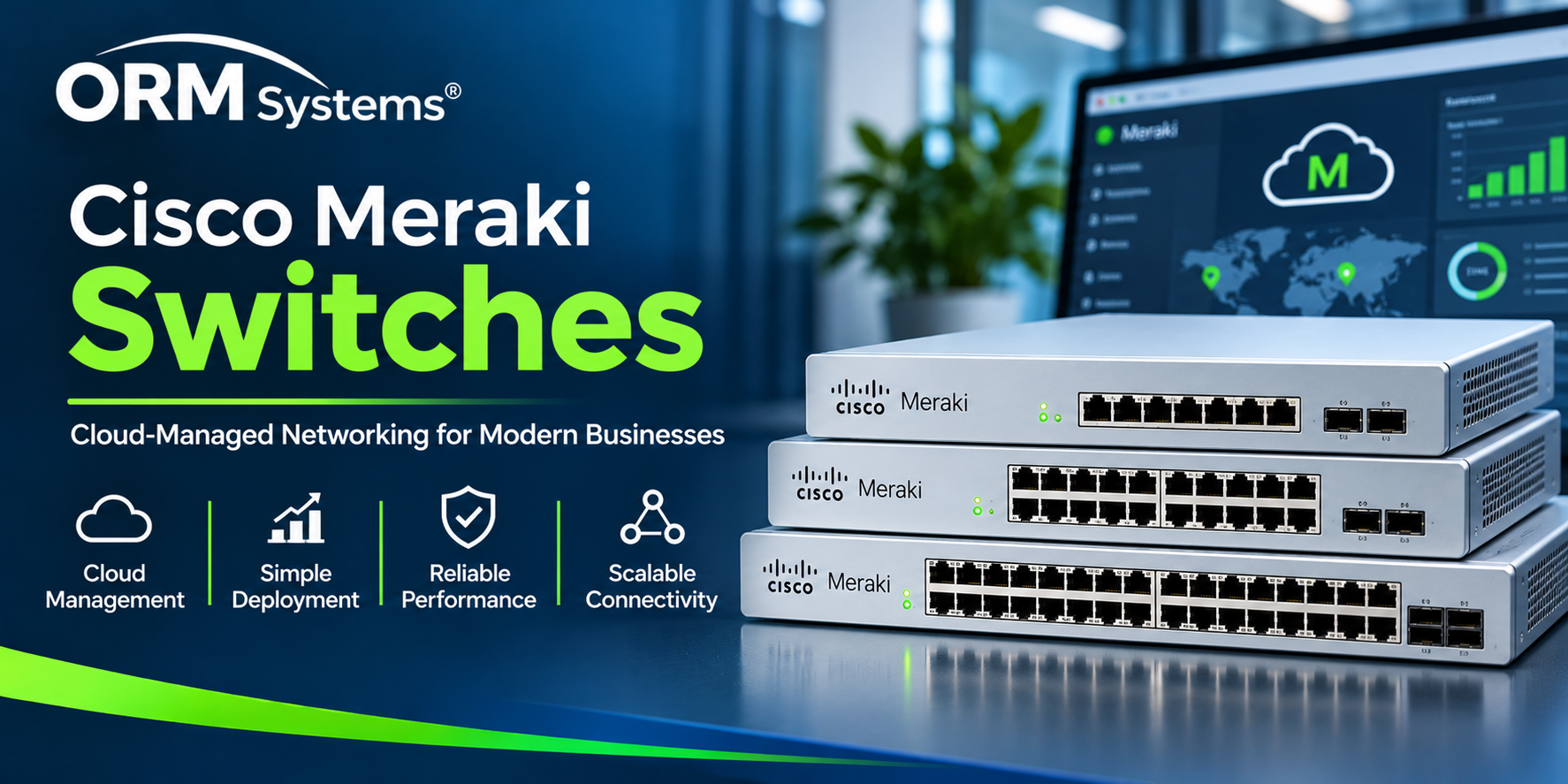
Modern businesses need secure, reliable, and easily managed networks to support daily operations. From connecting office computers and wireless access points to managing security cameras and cloud applications, network switches play an important role in maintaining communication across business environments.
Cisco Meraki Switches provide cloud-managed networking solutions designed to simplify deployment, monitoring, and management. These switches allow IT administrators to configure networks, monitor connected devices, and troubleshoot connectivity issues through a centralised management platform.
Whether managing a small office, multiple retail branches, or a large enterprise network, Cisco Meraki Switches offer different models to meet varying connectivity, performance, and scalability requirements.
What Are Cisco Meraki Switches?
Cisco Meraki Switches are managed Ethernet switches that use a cloud-based management platform called the Meraki Dashboard.
Unlike traditional switches that rely primarily on individual device configuration, Meraki switches allow administrators to manage multiple network devices through a central interface.
The switches are available in different port configurations, including Gigabit Ethernet, multigigabit connectivity, and high-speed uplink options.
Many models also support Power over Ethernet (PoE), allowing connected devices to receive data and electrical power through compatible Ethernet cables.
Cisco Meraki cloud-managed switches are commonly deployed in offices, educational institutions, retail businesses, healthcare facilities, and distributed enterprise networks.
Key Features of Cisco Meraki Switches
Centralised Cloud Management
One of the main advantages of Cisco Meraki Switches is their cloud-based management capability.
The Meraki Dashboard allows network administrators to monitor connected devices, configure supported settings, and examine network activity remotely.
For businesses operating multiple locations, centralised management reduces the need to configure every switch individually on site.
Administrators can also review alerts and identify potential connectivity issues through the management interface.
Power over Ethernet Support
Many Cisco Meraki Switches support PoE or PoE+, allowing compatible devices to receive power directly through Ethernet connections.
This technology is commonly used for IP phones, wireless access points, security cameras, and other networking equipment.
PoE support reduces the need for separate power adapters and can simplify installations.
However, businesses must verify the total PoE budget of each switch to ensure it can support the connected devices.
Network Security and Access Control
Cisco Meraki Switches include management and security features that help organisations control network access.
Supported capabilities may include VLAN configuration, access control lists, port security, and network authentication.
These features allow administrators to separate network traffic and apply access restrictions where appropriate.
Proper configuration remains essential because purchasing a managed switch does not automatically secure the entire network.
Remote Monitoring and Troubleshooting
Network administrators can use the Meraki Dashboard to review device status, port activity, and available diagnostic information.
Remote monitoring helps identify disconnected devices, configuration problems, and other network issues.
For businesses with several offices, this capability can reduce troubleshooting delays and unnecessary site visits.
Popular Cisco Meraki Switch Models
Cisco offers multiple Meraki switch families designed for different networking requirements.
Cisco Meraki MS130 Series
The Cisco Meraki MS130 Series is designed for modern branch offices and enterprise access networks.
These switches are available in different port configurations, including compact models and larger 24-port or 48-port options.
Selected models support PoE+, multigigabit Ethernet, and higher-speed uplinks.
The MS130 Series is suitable for businesses that need reliable access switching with cloud-based management.
Cisco Meraki MS150 Series
The Cisco Meraki MS150 Series provides stackable access switching for business environments requiring additional flexibility.
Selected models offer 24 or 48 Gigabit Ethernet ports, 10G uplinks, and PoE+ support.
Physical stacking allows compatible switches to operate together as a managed stack.
This makes the MS150 Series useful for organisations planning network expansion without introducing unnecessary management complexity.
Cisco Meraki MS225 Series
The Cisco Meraki MS225 Series provides cloud-managed access switching with Gigabit Ethernet ports and 10G SFP+ uplinks.
Available configurations include 24-port and 48-port models, with selected versions offering PoE+ capabilities.
The series supports organisations that require reliable access connectivity and centralised network management.
Businesses considering MS225 switches should also verify their product lifecycle and available support arrangements.
Cisco Meraki MS250 Series
The Cisco Meraki MS250 Series provides stackable managed switching with Layer 3 capabilities.
These switches are suitable for enterprise access environments requiring additional routing functionality and higher-capacity uplinks.
Selected models include PoE+ support, making them appropriate for networks connecting wireless access points, IP phones, and other powered devices.
Cisco Meraki MS350 and MS355 Series
The MS350 and MS355 families are designed for enterprise networks requiring advanced access switching capabilities.
The MS350 Series offers Gigabit Ethernet connectivity, while selected MS355 models support multigigabit connections.
Multigigabit switching is particularly useful when connecting compatible wireless access points that require more than 1 Gbps of Ethernet bandwidth.
These models can support demanding campus and enterprise network environments.
Benefits of Cisco Meraki Switches for Businesses
Simplified Network Administration
Managing networking equipment across multiple locations can require significant time and technical resources.
Cisco Meraki cloud management allows administrators to monitor supported switches through one interface.
This can simplify configuration, troubleshooting, and routine network administration.
Improved Network Visibility
The Meraki Dashboard provides information about connected devices and switch activity.
Administrators can use this visibility to investigate potential connectivity problems and monitor network performance.
Better visibility supports informed decisions about infrastructure maintenance and capacity planning.
Flexible Network Expansion
Businesses frequently expand their networking requirements as they add employees, devices, and locations.
Cisco Meraki Switches offer different port counts, uplink speeds, and PoE configurations.
Choosing a suitable model helps organisations expand connectivity while maintaining consistent management practices.
Cisco Meraki Switches for Different Industries
Corporate Offices
Corporate environments depend on reliable Ethernet connectivity for computers, communication systems, and wireless infrastructure.
Cisco Meraki Switches can connect these devices while allowing IT teams to manage network access centrally.
Retail Businesses
Retail organisations often operate several branches with similar networking requirements.
Meraki cloud management allows administrators to oversee supported switches across different stores.
This is useful for maintaining connectivity to point-of-sale systems, office equipment, and security devices.
Educational Institutions
Schools and universities require dependable connectivity across classrooms, administrative offices, and campus facilities.
Cisco Meraki Switches can support wired networks and compatible wireless access infrastructure.
Centralised monitoring helps administrators manage distributed network equipment more efficiently.
Healthcare Facilities
Healthcare organisations depend on reliable networking for communication, administrative systems, and connected infrastructure.
Meraki switches can support these environments when appropriately selected and configured.
Network segmentation, security policies, and suitable redundancy arrangements are particularly important for critical applications.
Cisco Meraki Licensing Requirements
Licensing is an important consideration when purchasing Cisco Meraki Switches.
Meraki cloud-managed switches generally require an appropriate active licence for management and operation within the supported licensing model.
Licensing arrangements vary by product family and may include Enterprise and Advanced feature tiers.
An Advanced licence is not available for every Meraki switch model, so buyers should verify the exact licensing options supported by their chosen hardware.
Businesses must also consider licence duration, renewal requirements, and the licensing model used by their organisation.
Failing to account for these costs can create unexpected long-term expenses.
How to Choose the Right Cisco Meraki Switch
Evaluate Port Requirements
The number of connected devices determines the required switch capacity.
A smaller office may need an 8-port or 24-port switch, while a larger environment could require 48 ports or multiple switches.
Businesses should also allow for reasonable future expansion.
Check Uplink Speeds
Uplink ports connect access switches to other networking equipment.
Depending on the model, Cisco Meraki Switches may provide 1G, 10G, or higher-speed uplinks.
The correct uplink capacity depends on expected traffic and the wider network design.
Calculate PoE Requirements
Businesses deploying powered devices should calculate the combined power requirements of connected equipment.
For example, multiple wireless access points and IP cameras may require a higher PoE budget than standard office computers.
Selecting a switch with sufficient power capacity helps prevent deployment problems.
Review Licensing and Support
Hardware specifications are only part of the purchasing decision.
Businesses should verify licence compatibility, subscription duration, warranty arrangements, and product support lifecycle.
These factors can significantly influence the total cost of ownership.
Cisco Meraki Switches Price and Buying Considerations
The Cisco Meraki Switches price depends on the series, port count, uplink configuration, PoE capabilities, product condition, and availability.
Compact models generally serve smaller networking environments, while enterprise switches with multigigabit ports, stacking capabilities, and larger PoE budgets may involve greater hardware costs.
For example, an organisation comparing MS130 and MS150 switches should consider whether physical stacking and additional uplink capacity justify the price difference.
Licensing costs must also be included in the purchasing budget.
A lower hardware price may not represent the best value when licence renewals, maintenance, accessories, and future expansion requirements are considered.
Why Choose ORM Systems for Cisco Meraki Switches?
ORM Systems supplies enterprise networking equipment, including Cisco Meraki Switches, Cisco Catalyst switches, routers, transceivers, and related infrastructure hardware.
Businesses can explore different Meraki models according to their network size, connectivity requirements, and available budget.
The product range includes solutions for smaller branch networks and larger enterprise environments.
When selecting equipment, buyers should confirm exact part numbers, product condition, licensing requirements, and compatibility with existing networking infrastructure.
Careful procurement helps organisations avoid unnecessary costs and select equipment suitable for long-term network operations.
Frequently Asked Questions About Cisco Meraki Switches
What are Cisco Meraki Switches used for?
Cisco Meraki Switches connect Ethernet devices within business networks and provide cloud-based management through the Meraki Dashboard. They are used in offices, retail locations, schools, healthcare facilities, and enterprise environments.
What is the difference between Cisco Meraki and Cisco Catalyst switches?
Cisco Meraki switches are designed around cloud-based management through the Meraki Dashboard. Traditional Cisco Catalyst switches commonly offer different management options, including command-line and controller-based administration. Some newer Catalyst platforms also support Meraki-managed operating modes.
Do Cisco Meraki Switches require a licence?
Yes. Cisco Meraki cloud-managed switches generally require an appropriate active licence. Available licensing tiers, terms, and operational requirements depend on the specific product and licensing model.
Are Cisco Meraki Switches suitable for small businesses?
Yes. Compact Meraki switch models can support smaller office networks requiring centralised management, Gigabit Ethernet connectivity, and optional PoE capabilities.
Do Cisco Meraki Switches support PoE?
Many Cisco Meraki Switches support PoE or PoE+. The number of powered ports and total power budget depend on the model.
Can Cisco Meraki Switches work without internet connectivity?
Meraki switches can continue forwarding traffic using their existing configurations during temporary cloud connectivity interruptions. However, cloud management, monitoring updates, and certain services require connectivity. Licensing status can also affect continued operation.
What is the difference between MS130 and MS150 switches?
The MS130 Series provides compact and enterprise access switching options, while the MS150 Series adds physical stacking capabilities on supported models. Both families offer cloud management and configurations with PoE support.
Can refurbished Cisco Meraki Switches be used?
Refurbished Meraki switches may be suitable when they are eligible for registration, supported, and compatible with the intended licensing arrangement. Buyers should verify device ownership transfer, claim status, warranty, and support eligibility before purchasing.
What affects Cisco Meraki Switches pricing?
Pricing depends on model specifications, port count, PoE capacity, uplink speed, equipment condition, availability, and licensing requirements.
Conclusion
Cisco Meraki Switches provide cloud-managed networking solutions that help businesses simplify administration, improve network visibility, and support connected devices across multiple locations.
From compact MS130 models to stackable MS150 switches and higher-capacity enterprise platforms, the Meraki range offers different configurations for varying network requirements.
The best purchasing decision depends on port capacity, uplink speed, PoE needs, licensing costs, and long-term support.
By evaluating these factors together, businesses can select reliable networking equipment that supports current operations and future infrastructure growth.
❤️ Support Friends Aim! View a sponsored ad to help cover our website costs. Thanks!
Support Us — Ad 1 Support Us — Ad 2- Arts, Culture & Design
- Automotive & Transport
- Accounting & Finance
- Advertising & Marketing
- Agriculture & Farming
- Business & Consulting
- Books & Publishing
- Building & Construction
- Beauty & Personal Care
- Baby, Kids & Parenting
- Charity & Social Causes
- Crafts & Handmade
- Careers & Jobs
- Computers & Laptops
- Consumer Electronics
- Entertainment & Events
- Food & Beverages
- Delivery & Logistics
- Digital Media & Content
- Dating & Relationships
- E-Commerce & Retail
- Education & Learning
- Energy & Environment
- Fitness
- Fashion & Apparel
- Gaming & Toys
- Government & Legal
- Gardening
- Health & Medical Care
- Home Decor & Furniture
- IT & Software
- Industrial & Tools
- Import & Export
- Jewelry & Watches
- Lifestyle & Wellness
- Legal Services & Law
- News & Media
- News & Current Affairs
- Religion & Faith
- Sports
- Technology
- Travel & Tourism
- Weddings & Events
- Other

 Arabic
 French
 Spanish
 Portuguese
 Deutsch
 Turkish
 Dutch
 Italiano
 Russian
 Romaian
 Portuguese (Brazil)
 Greek