


 About
 Terms
 Privacy
What Floodwater Leaves Behind: The Hidden Damage You Can't See After the Water Is Gone
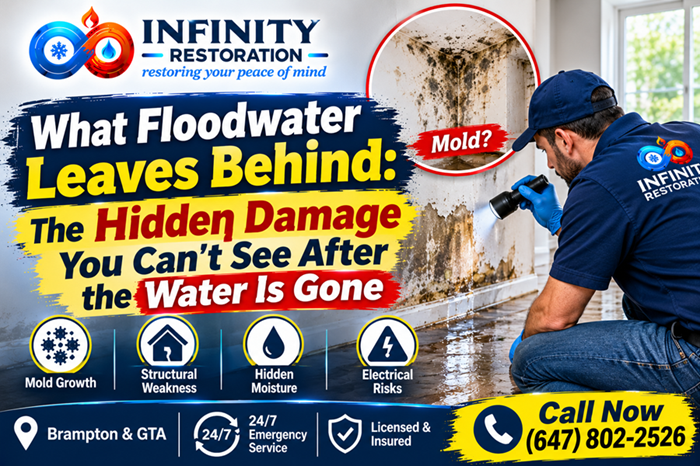
The pumps are quiet, the puddles are gone, and the basement floor looks dry. For many homeowners, that is the moment they relax and assume the worst is over. In reality, the visible water is often the smallest part of a flood. What remains behind walls, under flooring, and inside building materials continues to cause damage for days and weeks afterwards. Understanding what floodwater leaves behind explains why professional flood damage restoration Brampton homeowners rely on focuses so heavily on drying, testing, and verification, and not just on removing what you can see.
Why "Looks Dry" Is Not the Same as Dry
Building materials are porous. Drywall, insulation, wood framing, subfloors, carpet underlay, and concrete all absorb water like a sponge, and they release it slowly. A wall can feel perfectly dry on the surface while holding enough moisture inside to support mold. A floor can look fine while the plywood beneath it is soaked.
This is the central problem after any flood. Appearance and touch are unreliable. Only measurement tells you whether a structure has truly dried.
Hidden Damage 1: Moisture Inside Walls and Insulation
Water wicks upward through drywall, often climbing well above the visible waterline. Behind the surface, insulation can soak up water and stay wet for a long time, since it holds moisture and dries slowly. Wall cavities have little airflow, so damp materials inside them can stay wet for weeks if nobody opens them up or dries them with proper equipment.
Warning signs include bubbling or peeling paint, soft or crumbling drywall, stained baseboards, and a musty smell near the lower part of the wall.
Hidden Damage 2: Subfloors and Flooring
Under carpet, tile, vinyl, laminate, and hardwood sits a subfloor, often plywood or concrete, and a layer of adhesive or underlay. Water seeps into these layers, where it can cause swelling, delamination, warping, and bacterial growth. Hardwood and laminate often cup or buckle days after a flood, once the moisture has worked its way through. Carpet underlay acts like a sponge and rarely dries on its own.
Hidden Damage 3: Mold Growth
Mold needs moisture, and a flooded basement provides it. In many cases growth can start within 24 to 48 hours if materials remain damp. It often begins in places you will not see, such as inside walls, under flooring, behind baseboards, and around the base of wooden framing. Early signs can be subtle: a faint musty smell, a slight discolouration, or condensation that is slow to clear.
Our related guide on stopping mold before it starts after water damage covers the habits that reduce the risk in the weeks that follow.
Hidden Damage 4: Contamination in Porous Materials
Floodwater, especially from storms or sewer backup, can carry bacteria, silt, and other contaminants. These do not disappear when the water is removed. They settle into carpets, underlay, drywall, insulation, and wooden structures, and a surface wipe does not reach them. This is why porous materials that have absorbed contaminated water are often removed and replaced instead of dried and kept.
It is also why sewage backup cleanup involves protective equipment, disinfection, and safe disposal. Household cleaners and a wet vacuum are not designed for this level of contamination.
Hidden Damage 5: Electrical and Mechanical Systems
Basements often contain the furnace, water heater, electrical panel, outlets, wiring, and ductwork. Floodwater can corrode contacts, damage insulation on wires, and leave residue inside equipment. Problems may not show up immediately. Appliances and wiring that have been submerged or soaked should be inspected by a qualified professional before they are used again, and ducts that took on water may need cleaning.
Hidden Damage 6: Structural Materials
Wood framing, sill plates, and floor joists can absorb moisture, and prolonged dampness can weaken them or encourage decay. Metal fasteners may rust. Concrete holds water for a long time and can keep surrounding materials damp. None of this is visible without proper moisture mapping, and it matters most for the long-term health of the home.
Hidden Damage 7: Odours That Return
Lingering smells are one of the most common complaints weeks after a flood. They usually come from trapped moisture, microbial growth, or absorbed contamination in porous materials. Air fresheners cover them for a few days, but the smell returns until the source is dried, removed, or treated.
How Professionals Find What You Cannot See
Specialists use tools that make the invisible measurable:
- Moisture meters that read dampness inside drywall, wood, and concrete
- Thermal imaging cameras that reveal cool, wet areas behind surfaces
- Hygrometers that track humidity and temperature in the air
- Daily drying logs that record readings so progress is documented
Drying continues until readings match normal levels for the materials involved. Many basements need roughly three to five days of active drying with professional equipment, depending on the water level and materials. Verification before the job is closed is what protects you from mold and odours later.
Signs of Hidden Flood Damage Weeks Later
If you dried the space yourself, or only partly, watch for:
- A musty smell that comes and goes
- Paint that bubbles, peels, or stains
- Floors that cup, buckle, or feel soft
- Rust on screws, nails, or metal brackets
- Condensation or a persistently damp feeling in the basement
- Allergy-like symptoms that ease away from home
If you see any of these, an inspection is a sensible next step, since early action keeps the fix small.
What to Do If You Have Already Cleaned Up
Do not worry if you started drying on your own. Stop and reassess. Photograph what you see, note any smells or stains, and ask a professional to measure moisture in the affected walls and floors. It is far easier to confirm that the structure is dry now than to deal with mold and rot discovered later.
Documentation Matters for Insurance Too
Hidden damage is precisely the kind of loss that gets disputed, because it cannot be seen in a quick photograph. Moisture readings, thermal images, and drying logs create objective evidence of what was found and what was done. If you are weighing options, a clear record of the work performed supports your claim. Details vary by policy, so confirm coverage with your insurer.
Where Professional Help Fits
A thorough flood damage restoration Brampton response covers the full sequence: fast extraction, removal of materials that cannot be saved, cleaning and disinfection, structural drying with measurement, and rebuilding where needed. You can read more about that process in this overview of basement flood cleanup and flood damage restoration in Brampton. The aim is not just to remove the water but to return the home to a condition where nothing is left to cause trouble later.
Final Thoughts
When the water is gone, the work is only half done. Hidden moisture, contamination, and structural effects continue to develop if they are not found and treated. Measure instead of guessing, replace what cannot be saved, and verify dryness before you rebuild. Whether the cause was a storm or a backup, good storm damage cleanup and basement flood cleanup both end with measured dryness, not a guess.
Infinity Restoration is a Brampton-based restoration company offering flood damage restoration Brampton homeowners can call 24/7, along with water, fire, mold, odor, biohazard, asbestos, and reconstruction services under one team.
❤️ Support Friends Aim! View a sponsored ad to help cover our website costs. Thanks!
Support Us — Ad 1 Support Us — Ad 2- Arts, Culture & Design
- Automotive & Transport
- Accounting & Finance
- Advertising & Marketing
- Agriculture & Farming
- Business & Consulting
- Books & Publishing
- Building & Construction
- Beauty & Personal Care
- Baby, Kids & Parenting
- Charity & Social Causes
- Crafts & Handmade
- Careers & Jobs
- Computers & Laptops
- Consumer Electronics
- Entertainment & Events
- Food & Beverages
- Delivery & Logistics
- Digital Media & Content
- Dating & Relationships
- E-Commerce & Retail
- Education & Learning
- Energy & Environment
- Fitness
- Fashion & Apparel
- Gaming & Toys
- Government & Legal
- Gardening
- Health & Medical Care
- Home Decor & Furniture
- IT & Software
- Industrial & Tools
- Import & Export
- Jewelry & Watches
- Lifestyle & Wellness
- Legal Services & Law
- News & Media
- News & Current Affairs
- Religion & Faith
- Sports
- Technology
- Travel & Tourism
- Weddings & Events
- Other

 Arabic
 French
 Spanish
 Portuguese
 Deutsch
 Turkish
 Dutch
 Italiano
 Russian
 Romaian
 Portuguese (Brazil)
 Greek