


 About
 Terms
 Privacy
SAT Test Preparation in Singapore: A Step-by-Step Guide
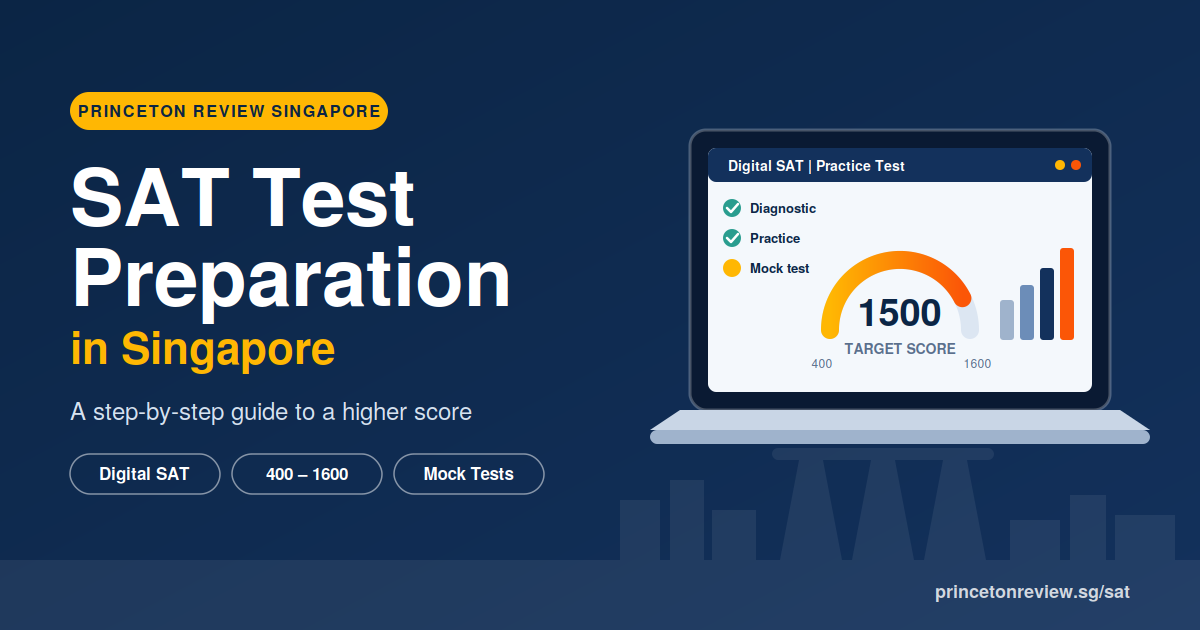
If you’re a student in Singapore aiming for a university in the US, UK, Canada or Australia, the SAT is often the first big hurdle. Good SAT test preparation follows a simple pattern: take a diagnostic test, set a target score, practise your weak areas, and rehearse on full-length digital mock tests, ideally with expert feedback. Students who follow this over 8 to 12 weeks, or longer, usually improve fastest.
What the Digital SAT Looks Like Today
The SAT is now taken on a laptop or tablet through the Bluebook app. Knowing the format makes your preparation far more efficient:
-
Two sections: Reading and Writing, and Math.
-
Adaptive testing: Each section has two modules, and the difficulty of the second depends on how you did in the first.
-
Shorter format: The test takes about two hours and 14 minutes, with short reading passages and one question per passage.
-
Scoring: The total score runs from 400 to 1600.
Always confirm the latest details on the College Board website before you register.
Step 1: Start With a Diagnostic Test
Before you open a prep book, sit a full-length practice test under timed conditions. It shows your baseline score and, more usefully, why you lose marks: content gaps, careless errors or pacing problems. Each needs a different fix, so skipping this step often leads to wasted study hours.
Step 2: Set a Realistic Target Score
Check the typical SAT scores of the universities on your shortlist, then work backwards. A student at 1150 aiming for 1400 needs a different plan from one at 1350 aiming for 1500. A clear target helps you decide how many hours to commit each week and whether self-study will be enough.
Step 3: Build a Timeline That Fits Singapore’s School Calendar
Singapore students juggle school exams, CCAs and projects, so timing matters.
-
Ideal: Start 3 to 6 months before your test date, studying a few hours a week alongside school.
-
Early starters: Secondary 3 or 4 students can build Math and reading foundations without pressure.
-
Short on time: An intensive bootcamp or crash course can work during school holidays if you already have solid fundamentals.
Put your test date, mock tests and school exam weeks on one calendar so they don’t collide.
Step 4: Practise With Purpose
Hours of unfocused practice don’t raise scores. Targeted practice does:
-
Drill by question type. Work on one skill at a time, such as grammar conventions, algebra or inference questions.
-
Keep an error log. Write down every mistake and why it happened, then review the log weekly.
-
Learn the test’s patterns. The SAT repeats question styles and answer traps. Recognising them saves time and prevents avoidable errors.
-
Use official materials alongside quality prep resources, so your practice matches the real exam.
Step 5: Rehearse Test Day on a Screen
Because the exam is digital, your final weeks should include full-length mocks on a device. Practise using the built-in tools, such as flagging questions and the on-screen calculator, and build the stamina to stay sharp for the full test. By test day, the format should feel familiar rather than new.
Why Singapore Students Choose Princeton Review
Self-study works for some students, but many benefit from structure and feedback. Princeton Review Singapore offers SAT preparation built around the way students actually learn:
-
Expert-led batch classes that teach content and test-taking strategy together
-
Full-length SAT mock tests that show where you stand and track progress
-
Proprietary books and online drills for focused practice between classes
-
Personalised study plans based on your score, goals and schedule
-
SAT bootcamp and crash course options for students on a tight timeline
The aim isn’t just to cover the syllabus. It’s measurable score growth, with clear strategies you can use under real test conditions.
Frequently Asked Questions
How long does SAT preparation take?
Most students need 8 to 12 weeks of consistent study. The right length depends on your starting score and your target.
When should I start SAT prep in Singapore?
Secondary 3 or 4 is a good time to build foundations. If you’re applying soon, begin at least three months before your test date.
Is SAT tuition better than self-study?
It depends on your discipline and goals. Self-study suits students who already know the format well. Tuition suits those who want expert strategies, feedback on mistakes and a structured schedule.
How many mock tests should I take?
Take one at the start, then one every 2 to 3 weeks, reviewing each in detail. Mocks are only useful if you analyse the mistakes afterwards.
Start Your SAT Preparation Today
A strong SAT score comes from planning, targeted practice and the right guidance, not last-minute cramming. If you’d like expert support, explore the SAT programmes at Princeton Review Singapore and take a mock test to find your starting point.
❤️ Support Friends Aim! View a sponsored ad to help cover our website costs. Thanks!
Support Us — Ad 1 Support Us — Ad 2- Arts, Culture & Design
- Automotive & Transport
- Accounting & Finance
- Advertising & Marketing
- Agriculture & Farming
- Business & Consulting
- Books & Publishing
- Building & Construction
- Beauty & Personal Care
- Baby, Kids & Parenting
- Charity & Social Causes
- Crafts & Handmade
- Careers & Jobs
- Computers & Laptops
- Consumer Electronics
- Entertainment & Events
- Food & Beverages
- Delivery & Logistics
- Digital Media & Content
- Dating & Relationships
- E-Commerce & Retail
- Education & Learning
- Energy & Environment
- Fitness
- Fashion & Apparel
- Gaming & Toys
- Government & Legal
- Gardening
- Health & Medical Care
- Home Decor & Furniture
- IT & Software
- Industrial & Tools
- Import & Export
- Jewelry & Watches
- Lifestyle & Wellness
- Legal Services & Law
- News & Media
- News & Current Affairs
- Religion & Faith
- Sports
- Technology
- Travel & Tourism
- Weddings & Events
- Other

 Arabic
 French
 Spanish
 Portuguese
 Deutsch
 Turkish
 Dutch
 Italiano
 Russian
 Romaian
 Portuguese (Brazil)
 Greek