


 About
 Terms
 Privacy
Organic Tallow Balm: What Animal-Derived Skincare Buyers Should Know
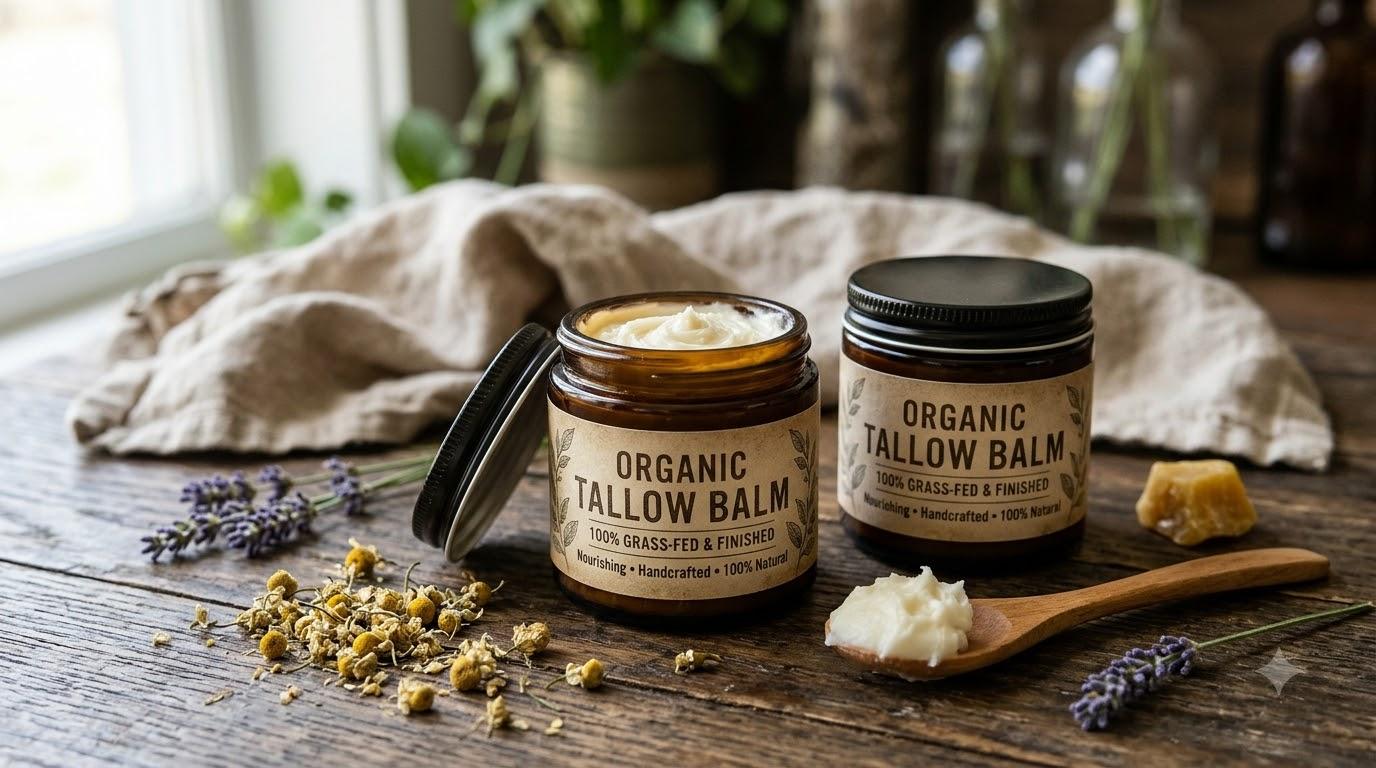
Organic Tallow Balm: How to Decide Whether It Fits Your Skincare Values
Choosing a moisturiser is not only about how it feels on the skin. Ingredient origin, animal welfare, environmental considerations, certification, and personal beliefs may also influence whether a product belongs in your routine. Before selecting organic tallow balm for your skincare routine, understand what the ingredient is, what an organic claim does and does not establish, and which alternatives are available if you prefer a plant-based formula.
Tallow is rendered animal fat, usually derived from cattle. It is different from plant oils such as jojoba, sunflower, or olive oil, even though both animal fats and plant oils can be used in skincare formulations. The word “organic” may describe the sourcing or certification of certain ingredients, but it does not change the fact that tallow is animal-derived.
The best choice depends on your priorities. Someone who values a rich balm and accepts animal-derived ingredients may evaluate the formula differently from someone who follows a vegan lifestyle or wants to avoid animal products for religious, ethical, or personal reasons.
What is tallow, and how is it used in skincare?
Tallow is produced by rendering animal fat. In skincare, it may be used as part of a balm intended to soften the skin and provide a rich, protective-feeling texture. Finished formulas can vary: some contain relatively few ingredients, while others include additional oils, waxes, fragrance, or botanical extracts.
The presence of tallow does not automatically establish that a balm is better than other moisturisers. It also does not tell you how the ingredient was sourced, what processing methods were used, or whether the finished product is appropriate for your skin.
Those questions require separate information. A product label may identify the ingredient, while the seller may need to provide additional details about sourcing or certification. If these details matter to your decision, ask rather than assuming that every tallow product follows the same standards.
What does the organic label establish?
Organic standards vary by jurisdiction and certification scheme. A claim may relate to specific agricultural ingredients or a defined part of production. It should not automatically be interpreted as certification of every component in a finished skincare product.
Organic sourcing also does not necessarily answer questions about animal welfare, transport, processing, environmental impact, or the full supply chain. Those issues may require different standards or more detailed sourcing information.
When evaluating a product, separate these questions:
-
Is the main ingredient animal-derived or plant-derived?
-
Does the seller identify the ingredient's source?
-
Is a specific organic certification named?
-
What does that certification cover?
-
Is the full ingredient list available?
-
Are the product's intended use and storage instructions clear?
This approach makes it easier to distinguish facts from assumptions. It also prevents the word “organic” from being treated as a universal guarantee of quality or suitability.
Comparing animal-derived and plant-based moisturisers
There is no single ingredient that works best for every person. The useful comparison is not whether animal or plant ingredients are inherently superior, but whether the finished product meets your needs and values.
|
Decision factor |
Tallow-based balm |
Plant-based moisturiser |
|
Ingredient origin |
Contains animal-derived fat |
Uses plant-derived ingredients, although the full formula should still be checked |
|
Texture |
Often rich or balm-like |
Ranges from light lotions to thick balms |
|
Vegan suitability |
Not suitable for a vegan product preference |
May be suitable, but verify all ingredients and manufacturing claims |
|
Sourcing questions |
Animal source, processing, and any relevant certification |
Plant source, cultivation, processing, and any relevant certification |
|
Skin compatibility |
Depends on the complete formula and individual response |
Also depends on the complete formula and individual response |
|
Environmental considerations |
Require information about the animal supply chain and production |
Require information about cultivation, land use, processing, and packaging |
|
Evidence of effectiveness |
Depends on the specific product and intended claim |
Depends on the specific product and intended claim |
A plant-based label does not automatically guarantee sustainability or low environmental impact. Likewise, an animal-derived ingredient does not by itself reveal the full environmental profile of the product. Detailed comparisons require evidence about sourcing, manufacturing, and packaging.
How to evaluate animal-welfare and sourcing claims
If the origin of the tallow is important to you, seek specific information instead of relying on broad language. Ask the seller whether the ingredient's source is documented, whether a certification applies, and what the certification verifies.
Be careful not to infer more than the information supports. A claim about one agricultural ingredient does not automatically establish every aspect of animal welfare. A general statement about responsible sourcing is not equivalent to a verifiable standard covering the full supply chain.
You may also have personal reasons for avoiding animal-derived ingredients that do not depend on the source. If you follow a vegan lifestyle, for example, a tallow-based formula will not meet that preference even if its ingredients are described as organic.
The goal is not to persuade every shopper toward one type of product. It is to help you make a decision that aligns with your values and the information you can verify.
A decision process for choosing the right formula
Use this sequence before buying a new moisturiser.
-
Define your main goal. Decide whether you want to moisturise rough areas, find a comfortable everyday face product, avoid particular ingredients, or prioritise sourcing values.
-
Identify non-negotiable requirements. These might include avoiding animal ingredients, avoiding fragrance, or requiring clear certification information.
-
Read the complete formula. Do not base your decision on the product name or one highlighted ingredient.
-
Verify claims that matter. Ask for details about certification, sourcing, or intended use if the product page is unclear.
-
Consider texture and application area. A rich balm may suit dry elbows but feel too heavy for someone with oily facial skin.
-
Introduce the product cautiously. Follow the directions and stop if irritation develops.
-
Reassess honestly. If the product does not feel comfortable or does not meet your values, there is no need to continue using it.
This process also prevents a common mistake: buying a product because its marketing sounds appealing before checking whether it meets your actual requirements.
What about skin benefits?
Tallow contains a mixture of fatty acids, and fat-based ingredients can contribute to an emollient texture. That does not establish that tallow is uniquely compatible with human skin or superior to conventional moisturisers.
High-quality clinical evidence on tallow skincare is limited. Claims that a tallow balm reliably treats eczema, acne, psoriasis, or other medical conditions should therefore be approached cautiously. Organic sourcing does not resolve those evidence limitations.
If your main concern is persistent dryness, a fragrance-free moisturiser with established ingredients may be worth discussing with a pharmacist or dermatologist. If you have a diagnosed skin condition, follow professional advice about treatment rather than relying on a product's marketing claims.
A product can be enjoyable to use without being a medical treatment. Keeping that distinction clear makes it easier to evaluate it fairly.
Illustrative Case Study: A shopper with specific ingredient preferences
Amira, a hypothetical shopper, wants a moisturiser for dry hands but prefers not to use animal-derived ingredients. She sees an organic tallow product and is initially attracted by its simple presentation.
After checking the ingredient list, she realises that the product does not meet her preference. She compares a plant-based cream and a plant-based balm, checking the complete formulas, fragrance information, directions, and sourcing claims. She chooses the option that meets her requirements and tests it cautiously.
Her decision is not based on a claim that plant-based products are universally better. It reflects her personal priorities and the fact that a product must fit both a practical need and a non-negotiable preference.
Reviewing a brand's information
Soul Seed Solutions offers tallow balm in its self-care range. You can explore Soul Seed Solutions to review the brand's product information. Before choosing a specific item, check the ingredients and any available sourcing details directly rather than assuming that the word “organic” answers every question.
If animal welfare, certification, or vegan suitability is essential to your decision, ask for the exact information needed to assess it. If the seller cannot clarify a requirement that matters to you, it is reasonable to choose another product.
Conclusion
Organic tallow balm may appeal to people who prefer a rich, animal-fat-based moisturiser, but it will not suit every person's values or skin needs. The organic label does not automatically prove superior performance, universal safety, or comprehensive animal-welfare standards.
Identify your requirements, check the complete formula, verify relevant sourcing claims, and choose a texture that suits the intended application area. If your skin problem is persistent or inflamed, seek professional advice rather than relying on a cosmetic balm alone.
Frequently Asked Questions
Is organic tallow balm vegan?
No. Tallow is animal-derived, so a product containing it does not meet a vegan ingredient preference.
Does organic tallow automatically mean better animal welfare?
Not necessarily. The meaning depends on the applicable standard and what it covers. Ask for specific sourcing or certification information if animal welfare is important to you.
Are plant-based moisturisers always better for the environment?
No. Environmental impact depends on sourcing, cultivation, processing, packaging, and other factors. The ingredient category alone is insufficient to determine the overall impact.
Is tallow balm better than plant-based moisturiser?
There is not enough high-quality evidence to establish that tallow is universally superior. Formula, skin type, personal tolerance, and individual preferences all matter.
Can I use tallow balm on my face?
Suitability depends on the finished formula and your skin. A rich balm may not suit everyone, particularly those who find heavy products uncomfortable or are prone to clogged pores.
What should I do if a brand's sourcing claims are unclear?
Ask for specific details about the ingredient source and any certification. If the information does not meet your requirements, consider another product.
❤️ Support Friends Aim! View a sponsored ad to help cover our website costs. Thanks!
Support Us — Ad 1 Support Us — Ad 2- Arts, Culture & Design
- Automotive & Transport
- Accounting & Finance
- Advertising & Marketing
- Agriculture & Farming
- Business & Consulting
- Books & Publishing
- Building & Construction
- Beauty & Personal Care
- Baby, Kids & Parenting
- Charity & Social Causes
- Crafts & Handmade
- Careers & Jobs
- Computers & Laptops
- Consumer Electronics
- Entertainment & Events
- Food & Beverages
- Delivery & Logistics
- Digital Media & Content
- Dating & Relationships
- E-Commerce & Retail
- Education & Learning
- Energy & Environment
- Fitness
- Fashion & Apparel
- Gaming & Toys
- Government & Legal
- Gardening
- Health & Medical Care
- Home Decor & Furniture
- IT & Software
- Industrial & Tools
- Import & Export
- Jewelry & Watches
- Lifestyle & Wellness
- Legal Services & Law
- News & Media
- News & Current Affairs
- Religion & Faith
- Sports
- Technology
- Travel & Tourism
- Weddings & Events
- Other

 Arabic
 French
 Spanish
 Portuguese
 Deutsch
 Turkish
 Dutch
 Italiano
 Russian
 Romaian
 Portuguese (Brazil)
 Greek