


 About
 Terms
 Privacy
Study in Australia: A Practical Guide for Singapore Students
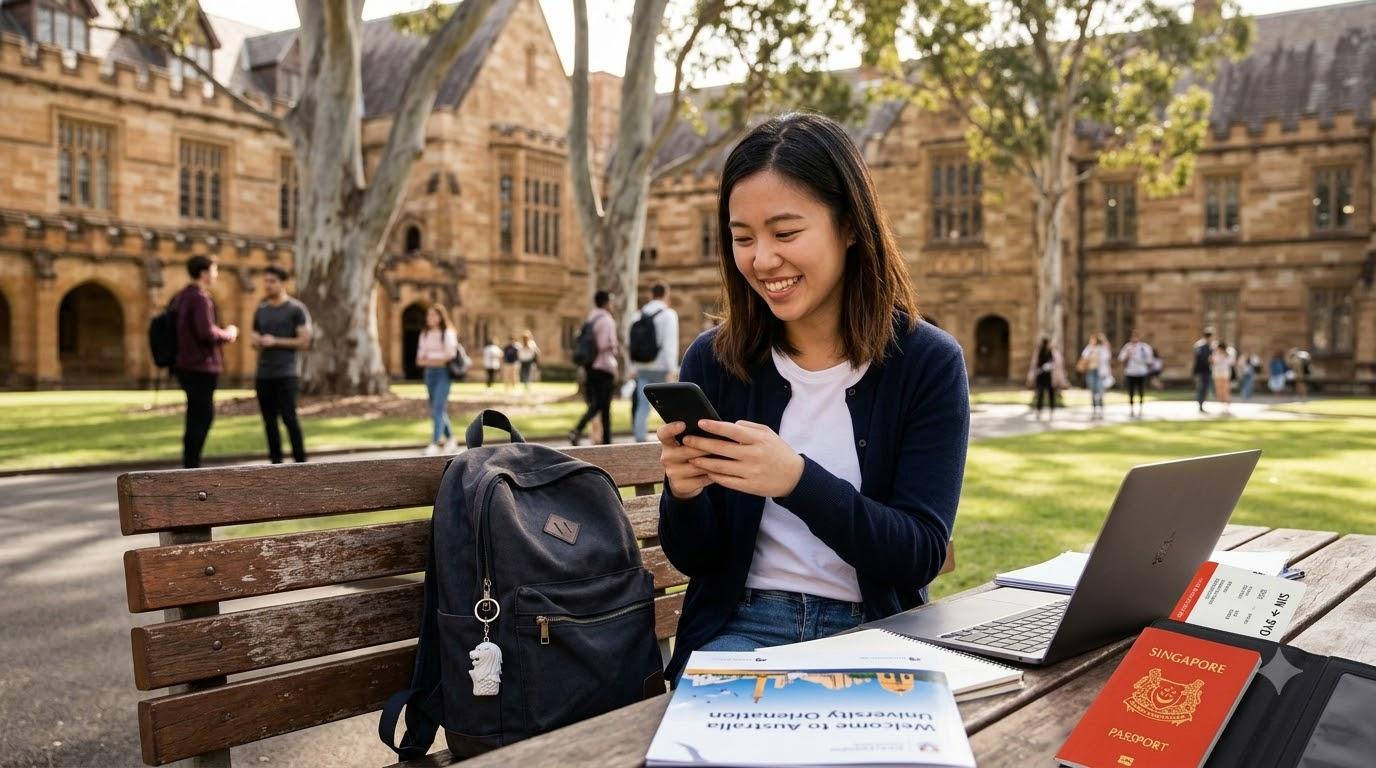
Study in Australia: How Singapore Students Can Choose the Right University and Avoid Costly Application Mistakes
To Study in Australia successfully, Singapore students should begin by matching their academic results, preferred subject, budget and long-term goals with suitable courses before submitting applications. Choosing a university based only on its reputation can lead to avoidable problems, such as discovering that a course has specific subject prerequisites, underestimating accommodation costs or missing an important application deadline.
A better approach is to compare courses first, confirm eligibility, prepare a realistic budget and organise the application and visa process in the correct order. Students and parents who want guidance with these decisions can explore how to plan to Study in Australia with a structured admissions strategy.
This guide explains how to make those decisions step by step, with practical examples for students progressing from Singapore secondary school, junior college or polytechnic studies.
1. Start With the Course, Not the University Name
One of the most common mistakes is choosing a university before deciding what to study. A university may have an excellent reputation overall, but that does not automatically make every course the best fit for your interests, academic background or career plans.
Begin by identifying two or three subject areas you genuinely want to explore. These might include business, engineering, computer science, health sciences, psychology or creative disciplines.
Then compare individual courses rather than relying on general university rankings.
Questions to ask before shortlisting a course
-
Does the course cover subjects that interest you?
-
Are there compulsory modules or opportunities to specialise?
-
Does admission require particular subjects or academic results?
-
Are internships, placements or practical projects included?
-
What is the course duration?
-
What are the tuition fees and additional expenses?
-
Does the course support your intended further study or career direction?
For example, a student interested in technology might compare computer science, software engineering and information systems. These fields can overlap, but their emphasis and course structures may differ.
Similarly, a student interested in healthcare should distinguish between different health-related degrees. Some professional programmes have specific prerequisite subjects, placement requirements or registration pathways that need to be checked carefully.
The objective is to find a course that fits your circumstances, not simply one with a familiar university name.
2. Understand How Your Singapore Qualifications Affect Admission
Australian universities assess international applicants according to the requirements of the particular institution and course. Your qualification, academic results, prerequisite subjects and English-language evidence may all affect eligibility.
Singapore students should not assume that every university uses the same admission criteria.
If you are studying in a Singapore junior college
If you are taking the Singapore-Cambridge GCE A-Level examinations, check how each shortlisted university assesses your qualification. Requirements can differ between courses, especially for programmes involving mathematics, sciences or other prerequisite subjects.
Do not wait until your final results are released to begin researching. You can investigate application timelines, required documents and possible course options beforehand.
If you are completing the IB Diploma Programme
Review the university's published IB requirements for the exact degree you want to pursue. Check the expected overall score, any subject-specific conditions and whether particular Higher Level subjects are required.
For example, a student applying for a quantitatively demanding programme should verify its mathematics prerequisites rather than assuming that a strong total IB score will satisfy every requirement.
If you are studying at a polytechnic
Check whether the university accepts your diploma for entry into the selected course. Ask whether admission is available directly into the first year or whether advanced standing or credit recognition may be considered.
Credit recognition is not automatic. It depends on the university, programme and assessment of your previous studies.
A simple eligibility checklist
Before paying an application fee or committing to a course, confirm:
-
The qualification you are completing is accepted.
-
Your academic results meet the stated entry criteria.
-
You have completed the required prerequisite subjects.
-
You understand any English-language requirements.
-
You can provide the necessary academic documents by the deadline.
If any requirement is unclear, request clarification from the university or an appropriately authorised admissions representative.
3. Compare Australian Universities Using Practical Criteria
University selection should involve more than ranking positions. The right choice depends on academic fit, affordability, location and the opportunities available within the course.
Use a comparison table to organise your shortlist.
|
Decision factor |
What to investigate |
Why it matters |
|
Course content |
Core modules, electives and specialisations |
Helps determine whether the degree matches your interests |
|
Entry requirements |
Qualification, grades and prerequisite subjects |
Reduces the risk of applying without meeting eligibility criteria |
|
Total cost |
Tuition, accommodation, transport and other expenses |
Helps you assess whether the option is financially realistic |
|
Location |
Transport, accommodation options and access to services |
Affects daily routines and living expenses |
|
Learning opportunities |
Projects, practical work and placement options |
Helps you understand how the course is delivered |
|
Student support |
Academic assistance, international student services and wellbeing support |
Helps you identify available support during your studies |
|
Future pathways |
Further study, professional recognition or relevant experience |
Helps you assess whether the course supports your goals |
How to narrow your shortlist
Start with several possible courses, then remove options that do not meet essential academic or financial requirements. Compare the remaining choices using the same criteria.
You may find that a less expensive course offers the modules you want, while a more prominent institution provides a particular specialisation or practical opportunity that matters to you. The best decision depends on your priorities.
Avoid choosing solely on the basis of a friend's recommendation. Their academic background, budget and career plans may be very different from yours.
4. Calculate the Full Cost Before Making a Decision
Tuition fees are only one part of the cost of studying overseas. Students also need to budget for accommodation, food, transport, learning materials, insurance and travel.
The cost of living varies by location and lifestyle. A budget that works for one student may be insufficient for another.
Build a realistic budget
Separate your estimated expenses into three categories.
Education expenses
-
Tuition fees and any required deposits.
-
Textbooks, software, equipment or course-specific materials.
-
Laboratory clothing, practical equipment or other programme requirements, where applicable.
Living expenses
-
Rent and accommodation-related charges.
-
Groceries and meals.
-
Public transport or other commuting expenses.
-
Phone service, personal necessities and occasional leisure activities.
Additional and one-off expenses
-
Flights and initial travel arrangements.
-
Visa-related charges and required documentation.
-
Overseas Student Health Cover (OSHC), where required.
-
Initial accommodation setup and emergency funds.
Use the university's published fees and current cost information for the city where you plan to live. Do not rely on a general estimate from a friend or an outdated online discussion.
Example: Comparing two hypothetical offers
Imagine a student receives offers from two universities for courses in the same broad field.
University A has lower tuition fees but would require more expensive accommodation and a longer daily commute. University B has higher tuition fees but offers a more convenient location and a course structure that better matches the student's interests.
The student should compare the total expected annual cost, not tuition alone. They should also consider the academic differences between the programmes before deciding whether the additional expense is justified.
The figures in this example are intentionally unspecified: actual fees and living expenses must be obtained from the relevant institutions and accommodation providers.
Do not confuse visa financial requirements with your actual budget
Meeting a student visa's financial-capacity requirements is not the same as proving that you can comfortably afford the entire experience. Your actual expenses may be higher than the minimum amount required for visa purposes.
Prepare a budget that reflects your intended accommodation, course fees and daily needs. Do not assume that part-time employment will cover a funding shortfall.
5. Research Scholarships Before You Finalise Your Budget
Scholarships can make an overseas degree more affordable, but students should examine their conditions rather than focusing only on the advertised award amount.
Possible opportunities may include university merit scholarships, awards for particular qualifications, faculty-specific schemes or other funding opportunities for international students.
For every scholarship you consider, check:
-
Whether Singapore citizens or international applicants with your qualification are eligible.
-
Whether you need to submit a separate application.
-
The academic results or other criteria required.
-
Whether the award is a one-off payment or recurring support.
-
Whether it covers tuition fees, living costs or only a portion of expenses.
-
Whether you must maintain a specified academic standard to keep the award.
Do not subtract a scholarship from your budget until you understand its eligibility conditions and whether you have actually been awarded it.
6. Prepare Your Application in the Right Order
A good application process reduces last-minute pressure and makes it easier to identify missing documents.
Follow this sequence when planning to get Admission in Australia.
Step 1: Create a course shortlist
Identify suitable courses at several institutions. Record the intake, application deadline, prerequisites and published tuition fees for each.
Step 2: Check eligibility carefully
Read the entry requirements for the exact course and qualification you are using. If you are waiting for final results, check whether predicted results or other preliminary evidence may be considered.
Step 3: Prepare your documents
Depending on your circumstances and the institution, you may need:
-
Academic transcripts and examination results.
-
Evidence of your current qualification or predicted results.
-
English-language test results, if required.
-
Identification documents.
-
A personal statement or other supporting material, where requested.
Some courses require additional information. Follow the university's own instructions rather than assuming that one document checklist applies everywhere.
Step 4: Submit applications and monitor updates
Complete each application accurately and submit the required documents before the deadline. Keep copies of the submitted information and check your email regularly for requests from admissions teams.
Step 5: Compare offers before accepting
Review the course details, conditions of the offer, fees, deposit requirements and relevant deadlines. If you have more than one offer, compare them against your original priorities rather than accepting the first one automatically.
Step 6: Plan the next steps after receiving an offer
Once you accept an offer and meet the institution's requirements, follow its enrolment process. For a student visa application, you will generally need the relevant Confirmation of Enrolment (CoE), along with the other documents required for your circumstances.
Allow time for each stage. An offer from a university does not, by itself, grant permission to enter Australia or begin studying there.
7. Understand the Student Visa Process
Admission and immigration are separate processes. Receiving a university offer does not guarantee that a student visa will be granted.
International students generally need to satisfy the relevant requirements for Australia's Student visa (subclass 500). These can include enrolment evidence, financial capacity, health insurance, health and character requirements, and the Genuine Student requirement.
Requirements and charges can change, so use the current official Australian Government guidance when preparing your application.
What should you prepare?
-
Check that your course and enrolment arrangements are appropriate for the visa application.
-
Review the latest document checklist for your circumstances.
-
Prepare evidence of sufficient funds in the required form.
-
Arrange OSHC for the required period, unless an exemption applies.
-
Answer the Genuine Student questions accurately and consistently with your circumstances.
-
Check the current visa application process, fees and processing guidance before submitting.
-
Allow adequate time for processing before making non-refundable travel arrangements.
The Genuine Student assessment requires you to explain your circumstances and reasons for choosing your course and Australia. Your answers should be truthful, specific and supported by the relevant evidence.
Singapore passport holders may be eligible for particular concessions affecting visa charges, but eligibility and the applicable amount should be confirmed through current official guidance. Do not rely on an old fee quoted in a blog post.
Illustrative Case Study: Choosing a Course Without Overstretching the Family Budget
Situation: A hypothetical Singapore student wants to study business in Australia after completing the IB Diploma Programme. The family has a defined budget and wants to compare several universities.
Initial problem: The student is attracted to one institution because of its reputation but has not checked the course structure, accommodation expenses or entry conditions.
Actions taken:
-
The student identifies the business subjects and specialisations that matter most.
-
The student checks the IB entry requirements for several relevant courses.
-
The family compares tuition fees, accommodation, transport and other likely expenses.
-
The student investigates scholarship eligibility without assuming that an award will be granted.
-
The family reviews the offers against the original academic and financial priorities.
-
After choosing a course, the student follows the university's enrolment instructions and prepares for the visa process using current requirements.
Expected outcome: The student and family can make a more informed decision because they have compared the actual course options and estimated the full cost. This process does not guarantee admission or a visa, but it helps reduce avoidable surprises.
Key lesson: A suitable university is one that meets the student's academic needs and fits the family's realistic financial plan—not necessarily the institution with the most recognisable name.
Common Mistakes Singapore Applicants Should Avoid
Applying before checking prerequisites: A strong overall academic result may not satisfy a course's specific subject requirements. Check both.
Underestimating living expenses: Include accommodation, transport, insurance and initial setup costs rather than looking at tuition alone.
Assuming scholarships are guaranteed: Treat awards as conditional until you receive confirmation and understand their terms.
Leaving documents until the last minute: Transcripts, supporting documents and responses to admissions requests can take time to organise.
Treating admission and the visa as the same decision: Plan for both processes, and do not assume that one guarantees the other.
Relying on outdated information: Fees, course requirements, scholarship conditions and visa procedures can change. Confirm current details before committing money or making travel arrangements.
How Admissions Guidance Can Help
Planning overseas study involves several connected decisions: course selection, eligibility, application timing, financial preparation and enrolment. Some students are comfortable managing these independently, while others may benefit from help organising their options and understanding application requirements.
Students and parents who want assistance with Study in Australia planning can explore the admissions support offered by Princeton Review Singapore. When considering any education adviser, ask what services are included, what fees apply, which institutions the adviser is authorised to represent, and which tasks remain your responsibility.
An education adviser can help with study choices and applications, but no adviser can guarantee admission, a scholarship, a visa or a particular career outcome. Immigration advice should be obtained from an appropriately authorised professional when it is needed.
Conclusion: Make Your Australian Study Plan Before You Apply
The strongest study plans begin with a clear academic objective and a realistic budget. Compare course content, check your qualification against the actual entry criteria, investigate funding and prepare your documents early. Once you receive an offer, review its conditions and plan the enrolment and visa steps carefully.
If your goal is to Study in Australia, take the first step by creating a shortlist of suitable courses and recording each course's entry requirements, fees, deadline and location. This simple comparison will help you move from a broad ambition to a practical plan that you and your family can evaluate confidently.
Frequently Asked Questions
1. Can Singapore students apply directly to Australian universities?
Many Australian universities accept applications from international students directly, although the application process varies by institution and course. Check the university's official instructions and whether you can apply directly or through an authorised education agent.
2. Do I need a specific IB score or A-Level result to get admitted?
There is no single academic threshold that applies to every Australian university and course. Requirements depend on the institution, qualification and programme. Check the current entry criteria and any subject prerequisites for each course you shortlist.
3. How much does it cost to study in Australia?
The total depends on the university, course, location, accommodation and lifestyle. Calculate tuition fees alongside rent, food, transport, insurance, travel and other expenses. Use current university fee information and location-specific estimates rather than relying on a single national figure.
4. Can international students receive scholarships?
Some universities and other organisations offer scholarships to eligible international students. Conditions differ, so check qualification requirements, deadlines, award coverage and renewal rules. Do not assume that you will receive an award until it has been confirmed.
5. Does receiving a university offer guarantee a student visa?
No. Admission and visa decisions are separate. You must meet the applicable student visa requirements and provide the required evidence. Check the latest official guidance before submitting your application.
6. When should I start planning my application?
Start researching well before your intended intake so you have time to compare courses, check prerequisites, organise documents and understand deadlines. The ideal timeline depends on your qualification, application route and the requirements of your chosen institution.
❤️ Support Friends Aim! View a sponsored ad to help cover our website costs. Thanks!
Support Us — Ad 1 Support Us — Ad 2- Arts, Culture & Design
- Automotive & Transport
- Accounting & Finance
- Advertising & Marketing
- Agriculture & Farming
- Business & Consulting
- Books & Publishing
- Building & Construction
- Beauty & Personal Care
- Baby, Kids & Parenting
- Charity & Social Causes
- Crafts & Handmade
- Careers & Jobs
- Computers & Laptops
- Consumer Electronics
- Entertainment & Events
- Food & Beverages
- Delivery & Logistics
- Digital Media & Content
- Dating & Relationships
- E-Commerce & Retail
- Education & Learning
- Energy & Environment
- Fitness
- Fashion & Apparel
- Gaming & Toys
- Government & Legal
- Gardening
- Health & Medical Care
- Home Decor & Furniture
- IT & Software
- Industrial & Tools
- Import & Export
- Jewelry & Watches
- Lifestyle & Wellness
- Legal Services & Law
- News & Media
- News & Current Affairs
- Religion & Faith
- Sports
- Technology
- Travel & Tourism
- Weddings & Events
- Other

 Arabic
 French
 Spanish
 Portuguese
 Deutsch
 Turkish
 Dutch
 Italiano
 Russian
 Romaian
 Portuguese (Brazil)
 Greek