


 About
 Terms
 Privacy
IB Physics Tuition: How to Improve Problem-Solving and Exam Performance
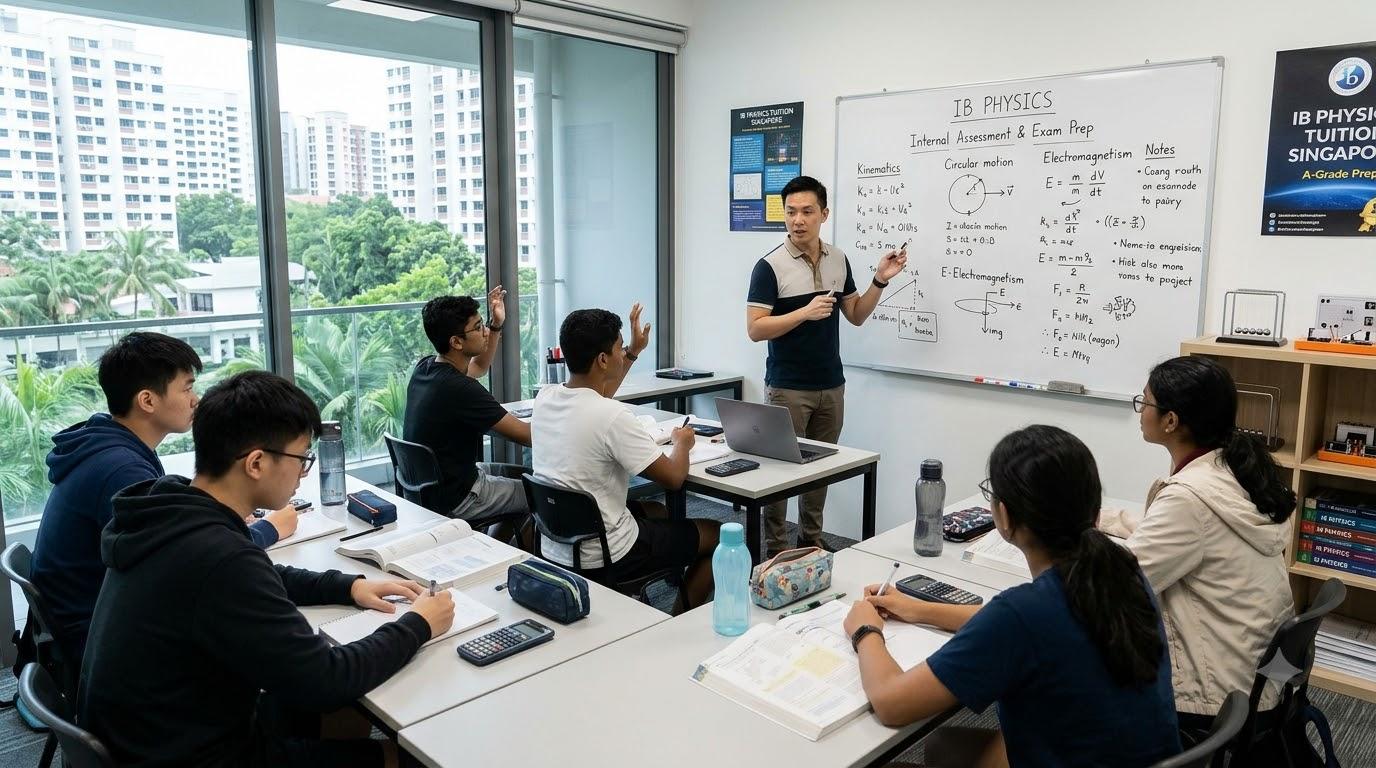
How to Stop Losing Marks in IB Physics: A Practical Problem-Solving Guide
IB Physics can feel difficult even when you understand the theory. You may recognise a formula, remember the relevant concept, and still lose marks because you chose the wrong equation, misunderstood a diagram, ignored units, or failed to explain your reasoning. The solution is to build a repeatable method for approaching unfamiliar questions. Students exploring ib physics tuition support for stronger problem-solving skills can use the same structured approach to identify weaknesses, practise deliberately, and prepare more effectively for examinations.
The goal is not simply to memorise more equations. It is to understand when and why a physical principle applies, translate the question into a mathematical model, and communicate the answer clearly enough to earn the available marks.
Why Understanding Physics Theory Does Not Always Lead to High Marks
Physics questions often require several skills at once. A student may understand Newton’s laws but struggle to identify the forces acting on an object. Another student may know the relationship between potential difference, current, and resistance but misapply it in a circuit containing several components.
These difficulties usually come from a gap between knowing a concept and using it independently.
1. Memorising formulas without understanding their conditions
A formula is useful only when its assumptions match the situation.
For example, the familiar equation (v=u+at) applies to motion with constant acceleration. If acceleration changes over time, the student must consider a different approach or work with the relevant graph and relationships.
Before selecting an equation, ask:
-
What physical quantity am I trying to find?
-
Which quantities are already known?
-
What assumptions does the equation require?
-
Does the question describe a situation in which those assumptions hold?
This short check can prevent a large number of avoidable errors.
2. Skipping diagrams and representations
A word problem can hide the physical relationships that make it easier to solve. Drawing a diagram forces you to identify objects, forces, directions, distances, or circuit connections.
For a mechanics question, a free-body diagram may reveal that weight and normal contact force are not necessarily equal if other vertical forces or acceleration are present. For a wave question, a sketch can help distinguish wavelength from amplitude.
The diagram does not need to be artistic. It needs to represent the physics accurately.
3. Treating calculations as isolated steps
A correct numerical answer is only one part of a strong solution. Students can lose marks through incorrect unit conversions, missing working, inappropriate significant figures, or an answer that contradicts the stated physical situation.
For instance, a calculated speed that exceeds a plausible limit in the scenario should prompt a review of the units, powers of ten, and equation selection. A numerical result should always be checked against the context.
A Reliable Five-Step Method for Solving IB Physics Questions
Use this process whenever a question involves several stages of reasoning.
Step 1: Identify the target quantity
Read the final part of the question first, then return to the information provided. Identify precisely what the question asks you to determine or explain.
Write down the target symbol if appropriate. For example, if the question asks for acceleration, mark (a) as the unknown.
Be alert to command terms. “Determine” generally requires an answer supported by working, while “explain” requires a physical reason or mechanism. “Compare” requires relevant similarities or differences, not two disconnected descriptions.
Step 2: Extract the known information
List the relevant values with their symbols and units. Convert values into consistent units before substituting them into equations.
For example, if a question gives a distance in kilometres and a time in seconds, convert the distance into metres when using SI units. If a value is presented in scientific notation, preserve its power of ten carefully.
Do not automatically use every number in the question. Some information may be included to test whether you can identify what is relevant.
Step 3: Represent the physical situation
Choose a suitable representation before calculating:
-
Mechanics: a free-body diagram, motion diagram, or velocity-time graph.
-
Electricity: a circuit diagram showing component connections and relevant quantities.
-
Waves: a sketch distinguishing wavelength, amplitude, and direction of propagation.
-
Thermal physics: an energy-transfer diagram or a clearly identified system.
-
Fields: a diagram showing field direction and the relevant objects or charges.
This stage helps you see which principle applies and makes your reasoning easier to communicate.
Step 4: Select the principle and show the working
Start with a relationship that describes the physical situation. Rearrange it symbolically before inserting numbers whenever that makes the calculation clearer.
Suppose an object starts from rest and accelerates uniformly at (2.0\ \text{m s}^{-2}) for (5.0\ \text{s}). Using (v=u+at):
[
v=0+(2.0)(5.0)=10\ \text{m s}^{-1}
]
The answer includes the relevant equation, substitution, result, and unit. If the question contains multiple stages, show enough working to make each stage understandable.
Step 5: Check whether the answer makes physical sense
Finish by checking three things:
-
Units: Does the final unit match the requested quantity?
-
Magnitude: Is the result plausible given the information?
-
Direction or sign: Does the sign or direction agree with the chosen convention and physical situation?
If the answer is a negative acceleration, for example, determine whether this indicates acceleration opposite to the chosen positive direction rather than assuming the result must be wrong.
How to Recognise the Right Equation Without Guessing
Equation selection becomes easier when you connect each relationship to the situation it describes.
|
Question pattern |
What to identify first |
Useful approach |
|
An object changes velocity over a stated time |
Initial velocity, final velocity, acceleration and time |
Use an appropriate constant-acceleration relationship if its assumptions hold |
|
A net force acts on an object |
Resultant force, mass and acceleration |
Apply Newton’s second law |
|
An electrical component is described by current and potential difference |
Component properties and circuit arrangement |
Select the relevant electrical relationship |
|
A wave travels a given distance during a period of time |
Frequency, wavelength, speed or time information |
Connect wave speed, frequency and wavelength where appropriate |
|
An energy transfer is described |
Initial and final energy stores or transfers |
Identify the relevant conservation or energy-transfer relationship |
|
Experimental measurements are supplied |
Variables, uncertainties and graph axes |
Examine trends, gradients, intercepts and uncertainty where relevant |
This table is a starting point, not a substitute for understanding. Two questions may mention the same physical quantities but require different reasoning because their assumptions or arrangements differ.
Improve Your Performance by Fixing the Type of Error
Repeating an entire question set is not always the best response to a poor result. First, identify why the marks were lost.
Conceptual errors
These happen when the underlying physics is misunderstood. A student might believe that an object moving at constant velocity must have a net force acting forward.
Better approach: Explain the concept in words before using an equation. If the velocity is constant, acceleration is zero, so the resultant force is zero under Newton’s second law.
Mathematical errors
These include rearranging equations incorrectly, entering values in the wrong order, and mishandling powers of ten.
Better approach: Practise rearranging equations without numerical values, then substitute numbers separately. Check calculator entries against the written expression.
Interpretation errors
These occur when the student overlooks a qualifier, reads the graph incorrectly, or answers a different question from the one asked.
Better approach: Underline the command term and identify the requested output before beginning the solution.
Communication errors
A student may understand the idea but provide an incomplete explanation. Writing “the current decreases” may not explain why it decreases.
Better approach: Link cause and effect. State the relevant physical change, explain the governing relationship, and connect it to the requested outcome.
A Weekly Practice Routine That Builds Exam Readiness
A useful revision routine should combine understanding, independent practice, and error correction. Students who seek structured guidance through ib physics tuition in Singapore should still maintain their own record of mistakes and practise applying feedback independently.
Try this four-part weekly routine:
-
Review one concept. Spend a focused session explaining a topic without relying entirely on notes. Write down the principles and conditions you remember.
-
Solve targeted questions. Choose questions that test the same concept in different contexts. Include both straightforward and unfamiliar applications.
-
Analyse every mistake. Record whether each error came from knowledge, equation selection, mathematics, interpretation, units, or communication.
-
Repeat selected questions later. Return to previously difficult questions after a gap. Check whether you can solve them without looking at the original solution.
Keep the routine realistic alongside other IB subjects and internal assessment work. Short, focused sessions with meaningful feedback are more useful than hours of copying worked solutions.
Example 1: A student who understands mechanics but struggles with unfamiliar questions
A student can explain Newton’s laws in class but becomes confused when an examination question introduces an inclined plane.
Rather than memorising a worked example, the student draws a diagram, identifies the forces, chooses axes, and resolves forces along the slope. The student then relates the resultant force to the acceleration.
The key improvement is not learning a new formula. It is applying a familiar principle to a new representation.
Example 2: A student who repeatedly loses marks in electricity
Another student can use basic electrical equations but struggles with questions involving combinations of components.
The student starts redrawing the circuit, identifies which components are in series or parallel, and works out the quantities that can be determined at each stage. The student checks whether the final current and potential differences are consistent with the circuit arrangement.
This approach replaces guesswork with a sequence of decisions.
Illustrative Case Study: Turning Repeated Mistakes into a Study Plan
Situation: A hypothetical IB Physics student performs inconsistently on timed practice questions. The student understands class explanations but struggles to finish unfamiliar problems independently.
Problem: Reviewing notes has improved recall, but the same calculation and interpretation errors continue to appear.
Actions taken:
-
The student reviews recent practice work and categorises each lost mark.
-
The student identifies three recurring problems: choosing equations without checking assumptions, skipping diagrams, and failing to include units.
-
For two weeks, the student practises a small set of questions focused on these weaknesses.
-
After each attempt, the student writes a brief explanation of the correct reasoning and revisits selected questions later without notes.
-
Timed practice is added gradually once the student can complete the questions accurately without time pressure.
Expected outcome: The student gains a clearer picture of the errors that need attention and develops a more consistent approach to unfamiliar problems. The routine does not guarantee a particular grade, but it makes revision more targeted and progress easier to evaluate.
Transferable lesson: Do not measure revision only by the number of questions completed. Measure whether you can explain the method, identify the relevant principle, and avoid repeating the same error.
When Should You Ask for Additional Help?
Independent practice is essential, but some difficulties are easier to resolve with feedback. Consider asking a teacher or tutor for help when:
-
You repeatedly misunderstand the same concept after reviewing it.
-
You can follow a worked solution but cannot begin a similar question independently.
-
You are unsure why a particular equation or assumption is appropriate.
-
Your written explanations do not clearly connect physical principles to conclusions.
-
You struggle to use feedback to improve later attempts.
A focused question is more productive than saying only that a topic is difficult. Bring a specific problem, show the method you attempted, and identify the step where your reasoning stopped making sense.
For students considering ib physics tuition, the most useful support should help them understand their errors, explain the reasoning behind each method, and gradually solve more questions without assistance. Tutoring should strengthen independent problem-solving rather than create dependence on model answers.
Common Revision Mistakes to Avoid
Memorising worked solutions: Remembering a familiar sequence can create false confidence. Change the context or values and check whether you still understand the underlying principle.
Practising only comfortable topics: Students often avoid difficult areas because they are frustrating. Allocate time to weak topics while maintaining skills in stronger areas.
Ignoring practical and experimental reasoning: Physics assessment can involve data, uncertainty, graph interpretation, and experimental design. Include these skills in revision rather than concentrating exclusively on calculations.
Checking answers without reviewing methods: A correct final answer does not prove that the reasoning is reliable. Compare your method with the expected physical approach and identify any unsupported steps.
Leaving timed practice until the end: Accuracy and speed are different skills. Build reliable methods first, then practise applying them within realistic time limits.
Conclusion: Make Every Practice Question Teach You Something
Improving in IB Physics requires more than remembering equations. You need to recognise the physical situation, select a suitable model, show clear working, interpret the result, and learn from errors. A consistent problem-solving routine makes these decisions easier to repeat under examination conditions.
Start by reviewing a recent set of questions and identifying your three most frequent error types. Build your next revision sessions around those weaknesses, and return to difficult questions after a gap to check whether your understanding has improved. If you need additional guidance, choose support that develops your reasoning and independence, not just your ability to copy a solution.
Frequently Asked Questions
1. Why do I understand IB Physics lessons but struggle with exam questions?
Classroom explanations often provide the principle and the next step. Examination questions require you to identify those steps independently, sometimes in unfamiliar contexts. Practise translating the wording into a diagram, identifying the target quantity, and justifying your equation choice.
2. Should I memorise every equation before solving past-paper questions?
You should know the equations and relationships required by your course, but memorisation alone is not enough. Understand the physical meaning, assumptions, and units associated with each relationship. Then practise deciding when it applies.
3. How can I reduce careless calculation mistakes?
Write down known quantities with units, rearrange the equation carefully, and enter the calculation only after checking the expression. At the end, check the unit, sign, and magnitude. Keep a record of recurring mathematical mistakes so you can practise them deliberately.
4. How often should I practise IB Physics questions?
Choose a schedule you can sustain alongside your other subjects. Regular, focused practice across the week generally makes it easier to revisit concepts and correct errors than relying entirely on a long session immediately before an assessment. Review quality matters as much as quantity.
5. Is getting help useful if I already attend Physics lessons at school?
Additional support may help if you need more individual feedback, alternative explanations, or a clearer plan for addressing repeated weaknesses. Bring specific examples of your work so the support can target the reasoning that needs improvement.
6. What should I look for when choosing IB Physics tuition?
Look for teaching that explains concepts clearly, demonstrates how to approach unfamiliar problems, provides feedback on your working, and encourages independent practice. You should be able to explain why a method works and apply it to a new question—not simply reproduce a model answer.
❤️ Support Friends Aim! View a sponsored ad to help cover our website costs. Thanks!
Support Us — Ad 1 Support Us — Ad 2- Arts, Culture & Design
- Automotive & Transport
- Accounting & Finance
- Advertising & Marketing
- Agriculture & Farming
- Business & Consulting
- Books & Publishing
- Building & Construction
- Beauty & Personal Care
- Baby, Kids & Parenting
- Charity & Social Causes
- Crafts & Handmade
- Careers & Jobs
- Computers & Laptops
- Consumer Electronics
- Entertainment & Events
- Food & Beverages
- Delivery & Logistics
- Digital Media & Content
- Dating & Relationships
- E-Commerce & Retail
- Education & Learning
- Energy & Environment
- Fitness
- Fashion & Apparel
- Gaming & Toys
- Government & Legal
- Gardening
- Health & Medical Care
- Home Decor & Furniture
- IT & Software
- Industrial & Tools
- Import & Export
- Jewelry & Watches
- Lifestyle & Wellness
- Legal Services & Law
- News & Media
- News & Current Affairs
- Religion & Faith
- Sports
- Technology
- Travel & Tourism
- Weddings & Events
- Other
❤️ Support Friends Aim! View a sponsored ad to help cover our website costs. Thanks!
Support Us — Ad 1 Support Us — Ad 2
 Arabic
 French
 Spanish
 Portuguese
 Deutsch
 Turkish
 Dutch
 Italiano
 Russian
 Romaian
 Portuguese (Brazil)
 Greek