


 About
 Terms
 Privacy
IB Economics Tuition: How to Improve Evaluation and Score Better in Essays
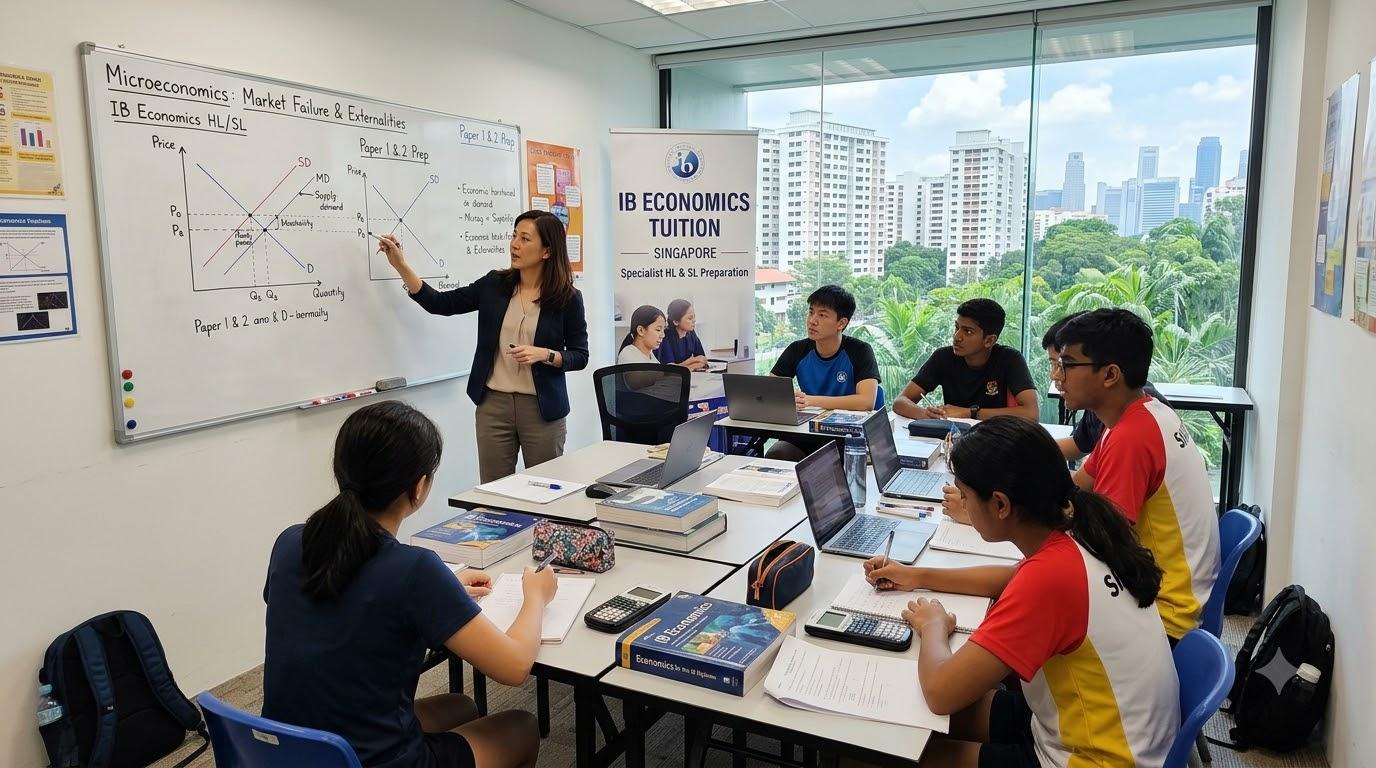
Why IB Economics Students Lose Marks in Essays—and How to Fix Their Evaluation Skills
Many IB Economics students understand supply and demand, inflation, unemployment and market failure but still struggle to turn that knowledge into high-quality exam answers. The problem is often not a lack of revision. It is the difficulty of applying economic theory to a particular question, explaining diagrams precisely and evaluating whether a policy will work in the real world. A structured approach to improving IB economics tuition outcomes through stronger essay skills can help students identify these weaknesses and practise more effectively.
The key is to stop treating Economics essays as collections of definitions. Strong answers build a logical argument, use relevant examples, explain economic mechanisms and evaluate the limitations of possible solutions. These skills can be developed through targeted practice rather than repeatedly memorising model essays.
1. Identify the Difference Between Knowing Economics and Applying It
A student may be able to define inflation perfectly but still struggle with a question asking whether higher interest rates are the best way to control it.
That is because the question requires more than a definition. The student must identify the type of inflation, explain how monetary policy affects aggregate demand, consider the possible consequences and judge whether the policy is appropriate in the circumstances.
This distinction matters throughout the IB Diploma Programme. Knowing the theory provides the foundation, but marks also depend on how effectively the student uses that theory to answer the question.
Three common weaknesses
Describing instead of explaining: Writing that higher interest rates reduce consumption is not enough. The student should explain that more expensive borrowing may discourage households from taking loans, while saving may become more attractive. This can reduce consumption and aggregate demand, depending on the circumstances.
Using theory without context: An answer about unemployment should not remain entirely general when the question provides information about a particular economy. The student should connect the explanation to the situation described.
Ignoring the command term: A question asking students to evaluate requires a judgement supported by reasoning. A response that only explains advantages may not meet the demands of the question.
2. Build an Evaluation Framework That Goes Beyond Advantages and Disadvantages
Evaluation is one of the most difficult skills to develop because students often assume it means listing one benefit and one drawback.
A stronger evaluation considers why an economic policy might work, what limits its effectiveness and which circumstances influence the final judgement.
For example, expansionary fiscal policy may increase aggregate demand during a recession. However, its effectiveness can depend on the size and timing of government spending, the state of the economy, implementation delays and the availability of productive resources.
Four useful evaluation questions
When analysing a policy, ask:
-
How effective is it? Explain the mechanism through which the policy could achieve its objective.
-
What determines its success? Consider the economic conditions, the scale of intervention and the likely response of households and firms.
-
What are the trade-offs? Examine possible consequences for government debt, inflation, income distribution or other objectives.
-
What is the final judgement? State when the policy is likely to be appropriate and identify any important limitations.
This framework should guide the argument rather than appear as a mechanical checklist in every paragraph.
Example: Raising indirect taxes to reduce consumption
An indirect tax on a product with negative externalities, such as a good whose consumption imposes costs on others, can raise its price and reduce quantity demanded. The policy may help internalise some external costs.
However, the result depends on factors such as price elasticity of demand, the size of the tax and whether consumers have accessible substitutes. If demand is relatively inelastic, consumption may fall only slightly. The tax may also place a disproportionate financial burden on lower-income households.
A balanced judgement would consider both the likely reduction in consumption and the distributional consequences, alongside other possible interventions.
3. Use Diagrams as Part of the Explanation, Not as Decoration
Economic diagrams are useful only when they support the argument. Drawing a diagram without explaining its movements may leave the examiner unsure whether the student understands the underlying mechanism.
Before drawing, identify the market or economic model relevant to the question.
For instance, a question about a contractionary monetary policy may require an aggregate demand and aggregate supply diagram. A question about a negative production externality may require a diagram comparing private and social costs.
A practical diagram checklist
-
Label both axes accurately.
-
Name the relevant curves.
-
Mark the original equilibrium.
-
Show the correct shift or movement.
-
Identify the new equilibrium where appropriate.
-
Explain the change in price level, output, quantity or welfare.
-
Connect the diagram directly to the question.
A diagram should be accompanied by a clear explanation. If aggregate demand shifts left, explain why the policy causes that shift and how the new equilibrium relates to the economic objective.
Avoid these diagram mistakes
|
Mistake |
Why it weakens the answer |
Better approach |
|
Missing axis labels |
Makes the model unclear |
Label variables before drawing curves |
|
Shifting the wrong curve |
Misrepresents the economic mechanism |
Identify what changes first |
|
No equilibrium labels |
Makes the result difficult to follow |
Mark initial and final equilibria |
|
Diagram unrelated to the question |
Adds little analytical value |
Explain the connection explicitly |
|
Incorrect curve movement |
Undermines the economic reasoning |
Practise the model before using it under exam conditions |
4. Improve Essay Structure With a Repeatable Reasoning Process
Students often write long paragraphs that contain correct facts but lack a clear chain of reasoning. A useful solution is to plan the logic before writing the final response.
A well-developed analytical paragraph usually contains a claim, an economic mechanism, an application and a link to the question. Evaluation can then consider the limitations of that argument.
A step-by-step essay planning method
Step 1: Decode the question. Identify the command term, the economic concept and the exact issue you must address.
Step 2: Select relevant theory. Choose the model that explains the problem rather than trying to include every concept from the topic.
Step 3: Plan the mechanism. Write down what changes, why it changes and what happens next.
Step 4: Choose a suitable diagram. Ensure the diagram illustrates the mechanism you intend to explain.
Step 5: Add context. Use the information in the question or a relevant, accurately described example.
Step 6: Develop evaluation. Identify the assumptions, conditions, trade-offs or unintended consequences that matter most.
Step 7: Reach a supported conclusion. Answer the question directly instead of simply repeating the earlier analysis.
Students using IB economics tuition in Singapore should practise this process with different command terms and question styles so that the method becomes flexible rather than memorised.
5. Practise the Command Terms That Require Different Types of Answers
Not every Economics question should be approached in the same way. The wording determines the depth and type of response required.
|
Command term |
Main task |
Common mistake |
|
Define |
Give the precise meaning |
Adding unnecessary discussion |
|
Explain |
Show how or why something happens |
Stating an outcome without the mechanism |
|
Analyse |
Develop linked economic reasoning |
Listing unrelated facts |
|
Discuss |
Examine relevant arguments and perspectives |
Presenting only one side |
|
Evaluate |
Weigh evidence, conditions and limitations to reach a judgement |
Giving advantages and disadvantages without a supported conclusion |
The exact demands depend on the question and assessment criteria. Students should always read the wording carefully instead of relying on a fixed essay formula.
Example: Explain versus evaluate
If asked to explain how an increase in government spending may affect output, the answer should focus on the mechanism linking spending to aggregate demand and real output, while recognising that outcomes depend on economic conditions.
If asked to evaluate whether increasing government spending is the best way to reduce unemployment, the student needs to compare its likely effectiveness with relevant alternatives, consider possible delays and trade-offs, and reach a reasoned judgement.
The second question requires a broader decision, not simply a longer explanation of the first.
6. Use Timed Practice to Diagnose Specific Problems
Repeatedly completing full papers is not always the most efficient way to improve. Students need to identify the particular skill that is costing them marks.
One student may struggle to interpret questions. Another may know the theory but draw inaccurate diagrams. A third may write strong analysis but fail to evaluate.
A targeted practice session should focus on one or two weaknesses at a time.
A practical weekly routine
-
Session 1: Review one economic concept and explain its mechanism without notes.
-
Session 2: Practise diagrams, including labels, shifts and explanations.
-
Session 3: Write a timed analytical paragraph using a past-paper question.
-
Session 4: Develop evaluation and compare alternative arguments.
-
Session 5: Review mistakes and rewrite the weakest section.
The schedule can be adjusted around schoolwork, internal assessments and other subjects. Consistent, focused practice is generally more useful than attempting an unrealistic daily workload that cannot be maintained.
7. Learn From Mistakes Instead of Collecting Model Answers
Reading model answers can help students understand what a well-developed response looks like. However, memorising entire essays is risky because the actual question may use a different context, command term or economic problem.
A mistake log turns practice into a more useful learning process.
Record the question, the mistake, why it occurred and the action needed to correct it. Categories might include theory, diagrams, application, evaluation, time management and question interpretation.
Review the log regularly. If the same mistake appears repeatedly, make it the focus of the next practice session.
Illustrative Case Study: Improving a Weak Evaluation Paragraph
Consider a hypothetical IB student who understands monetary policy but repeatedly writes conclusions such as, “Higher interest rates are effective because they reduce inflation.”
The statement is incomplete because it does not identify the conditions under which the policy is likely to work or the costs it may create.
The student begins analysing the source of inflation before selecting a policy. They then explain how interest rates affect borrowing and aggregate demand, consider the effect on investment and consumption, and distinguish demand-pull inflation from inflation driven primarily by supply-side factors.
After each practice essay, the student checks whether the conclusion follows from the analysis rather than appearing as an unsupported opinion.
The expected benefit is a more developed argument and a clearer understanding of evaluation. This is an illustrative scenario, not a report of a verified student's results.
8. Know When Additional Academic Support May Help
Independent study is essential, but it can be difficult to diagnose your own reasoning errors. A teacher or tutor can identify whether the problem lies in economic understanding, exam technique, diagram accuracy or evaluation.
For students considering IB economics tuition, the important question is whether the support addresses a specific learning need. Sessions should include active problem-solving, feedback on written answers and opportunities to correct mistakes.
Before choosing support, ask:
-
Will my written answers receive detailed feedback?
-
Can I practise diagrams and explain the reasoning behind them?
-
Will lessons address the command terms and assessment criteria?
-
Can the study plan adapt to my current weaknesses?
-
Will I receive practice tasks that I can complete independently?
The aim is to develop skills that students can use without assistance during examinations.
Students can explore IB Economics learning and tuition support options to understand the available subject-specific support and decide whether it suits their needs.
Conclusion: Turn Economic Knowledge Into Better Exam Answers
Improving Economics performance requires more than learning definitions and memorising diagrams. Students need to explain economic mechanisms, apply theory to the question, evaluate policy choices and support conclusions with relevant reasoning.
Start by identifying your most frequent mistakes. Practise the specific skills that need improvement, review feedback carefully and rewrite weak answers. Over time, this process can make exam preparation more focused and help you produce clearer, more analytical responses.
Frequently Asked Questions
1. Why do IB Economics students lose marks even when they know the theory?
They may struggle to apply concepts to the question, explain causal relationships, use diagrams accurately or develop evaluation. Understanding theory is necessary, but the answer must also meet the question's specific demands.
2. How can I improve evaluation in Economics essays?
Consider the assumptions behind each argument, the conditions that affect a policy's success, its possible trade-offs and relevant alternatives. Finish with a judgement supported by the analysis.
3. Should I memorise model essays?
Use model answers to study structure and reasoning, but avoid memorising complete responses. Practise applying economic concepts to unfamiliar questions and contexts.
4. How often should I practise past-paper questions?
Choose a sustainable schedule based on your workload and current weaknesses. Short, focused practice sessions can help you diagnose problems before you attempt complete timed papers.
5. Are diagrams necessary in every Economics answer?
Not necessarily. Use a diagram when it helps explain the relevant economic mechanism and directly supports the question. An accurate, well-explained diagram is more useful than an irrelevant one.
6. What should I look for in IB Economics tuition?
Look for subject-specific explanations, detailed feedback, diagram practice, evaluation training and a plan that addresses your weaknesses. Support should help you become more independent, not simply provide answers to memorise.
❤️ Support Friends Aim! View a sponsored ad to help cover our website costs. Thanks!
Support Us — Ad 1 Support Us — Ad 2- Arts, Culture & Design
- Automotive & Transport
- Accounting & Finance
- Advertising & Marketing
- Agriculture & Farming
- Business & Consulting
- Books & Publishing
- Building & Construction
- Beauty & Personal Care
- Baby, Kids & Parenting
- Charity & Social Causes
- Crafts & Handmade
- Careers & Jobs
- Computers & Laptops
- Consumer Electronics
- Entertainment & Events
- Food & Beverages
- Delivery & Logistics
- Digital Media & Content
- Dating & Relationships
- E-Commerce & Retail
- Education & Learning
- Energy & Environment
- Fitness
- Fashion & Apparel
- Gaming & Toys
- Government & Legal
- Gardening
- Health & Medical Care
- Home Decor & Furniture
- IT & Software
- Industrial & Tools
- Import & Export
- Jewelry & Watches
- Lifestyle & Wellness
- Legal Services & Law
- News & Media
- News & Current Affairs
- Religion & Faith
- Sports
- Technology
- Travel & Tourism
- Weddings & Events
- Other

 Arabic
 French
 Spanish
 Portuguese
 Deutsch
 Turkish
 Dutch
 Italiano
 Russian
 Romaian
 Portuguese (Brazil)
 Greek