


 About
 Terms
 Privacy
Pulmonary Function Test for Asthma in Bangalore: What to Know
Pulmonary Function Testing for Asthma: How to Prepare and Understand Your Results
A pulmonary function test for asthma in Bangalore can help a healthcare professional evaluate breathing difficulties, investigate suspected asthma, or monitor lung function in someone with an existing diagnosis. The appropriate test depends on the person's symptoms and medical history, so the first step is to consult a clinician and confirm which assessment is needed. Patients can review available pulmonary function testing options for asthma assessment before arranging an appointment.
Asthma can cause wheezing, coughing, chest tightness, and shortness of breath. These symptoms may vary over time, and a person can feel relatively well between episodes. Because several other conditions can cause similar symptoms, a healthcare professional may use lung function measurements alongside the patient's history and examination.
Understanding how testing works helps patients prepare, ask better questions, and avoid interpreting a single measurement as a complete diagnosis.
Why Is Lung Function Testing Used for Asthma?
Asthma is a respiratory condition involving inflammation and narrowing of the airways. The degree of airflow limitation can change, and symptoms may be triggered by exercise, allergens, respiratory infections, smoke, or other exposures.
Lung function testing provides objective information about breathing. Spirometry is commonly used to measure how much air a person can forcefully exhale and how quickly they can do so. The findings may help a clinician identify airflow obstruction and assess whether airflow improves after a bronchodilator medicine.
Testing is useful because symptoms alone do not always establish whether asthma is present. A person may report wheezing but have normal breathing measurements when symptoms are absent. Conversely, abnormal airflow measurements may have causes other than asthma.
Depending on the situation, the clinician may recommend repeat spirometry, peak expiratory flow monitoring, or another assessment. Not every patient needs the same combination of tests.
When Might a Clinician Recommend Testing?
A clinician may consider lung function assessment when someone experiences:
-
Repeated wheezing or chest tightness.
-
Coughing that occurs at night or during physical activity.
-
Breathlessness that comes and goes.
-
Respiratory symptoms associated with particular exposures.
-
Persistent symptoms despite an existing treatment plan.
-
A need to review lung function over time.
These symptoms are reasons to seek assessment, not proof that a person has asthma. The clinician may also consider other causes, including respiratory infections, allergies, heart conditions, or other lung diseases.
Anyone experiencing severe breathlessness, difficulty speaking because of breathing problems, blue or grey lips, or rapidly worsening symptoms should seek emergency medical care rather than waiting for a scheduled test.
Which Tests May Be Used to Assess Asthma?
Different tests answer different clinical questions. Understanding their purpose can help you discuss the plan with your healthcare professional.
Spirometry
Spirometry measures airflow during forced breathing. It commonly reports forced expiratory volume in one second (FEV1), forced vital capacity (FVC), and the relationship between these values.
A reduced FEV1/FVC ratio can indicate airflow obstruction, although interpretation depends on appropriate reference values and clinical context.
Bronchodilator response testing
In some assessments, spirometry is performed before and after a bronchodilator medicine. The clinician evaluates whether airflow measurements improve after the medicine.
Evidence of a significant response can support an asthma diagnosis in the appropriate context, but the result is not interpreted in isolation. The test protocol and criteria used should follow the relevant clinical guidance.
Peak expiratory flow monitoring
A peak flow meter measures how quickly a person can expel air. A clinician may recommend repeated measurements over time when investigating variable airflow or monitoring an established condition.
This approach provides a different type of information from a single spirometry session. Patients should receive instructions about when and how to take measurements and how to record them.
Additional investigations
If the initial findings do not explain the symptoms, a clinician may consider other assessments. The choice depends on the person's age, medical history, symptom pattern, and the results already available.
A more extensive investigation is not automatically better for every patient. Testing should answer a clear clinical question.
Comparison Table: Asthma Assessment Options
|
Assessment |
Main purpose |
Important limitation |
|
Spirometry |
Measures airflow and exhaled volumes |
Results may be normal between symptomatic episodes |
|
Spirometry with bronchodilator |
Evaluates changes in airflow after medicine |
A lack of significant change does not automatically exclude asthma |
|
Peak flow monitoring |
Tracks airflow variation over time |
Depends on correct technique and consistent recording |
|
Clinical assessment |
Reviews symptoms, history, examination, and other findings |
May require objective testing to clarify the diagnosis |
|
Additional respiratory investigations |
Addresses selected unresolved diagnostic questions |
Should be chosen according to individual clinical need |
The best assessment is the one that addresses the clinical question. Your healthcare professional can explain why a particular procedure has been selected and whether further investigation may be needed.
How to Prepare for an Asthma-Related PFT
Preparation is particularly important when the purpose of the test is to investigate variable airflow or assess a response to medicine.
Follow this process before attending.
-
Confirm the reason for testing. Ask whether the assessment is intended to investigate suspected asthma, monitor a known condition, or evaluate treatment response.
-
Review your medicines with the clinician. Tell the testing team about inhalers, oral medicines, and any recent changes in treatment. Some medicines can influence the measurements, but you should never stop or delay prescribed asthma treatment without professional instructions.
-
Record your symptoms. Note when coughing, wheezing, or breathlessness occurs, whether it interrupts sleep, and whether particular activities or exposures appear to trigger it. This information may help the clinician interpret the findings.
-
Ask about recent illness. Inform the centre if you have a respiratory infection or a recent worsening of symptoms. The testing team can advise whether the appointment should proceed.
-
Follow preparation instructions. Confirm any restrictions relating to meals, smoking, or strenuous exercise. Requirements can vary by procedure.
-
Bring previous reports. Earlier spirometry results or other respiratory investigations may help the clinician compare measurements over time.
-
Ask what happens after testing. Find out when the report will be available and whether a follow-up consultation is required.
These steps help ensure that the assessment is performed for the intended purpose and that the findings can be reviewed in context.
What Happens During the Appointment?
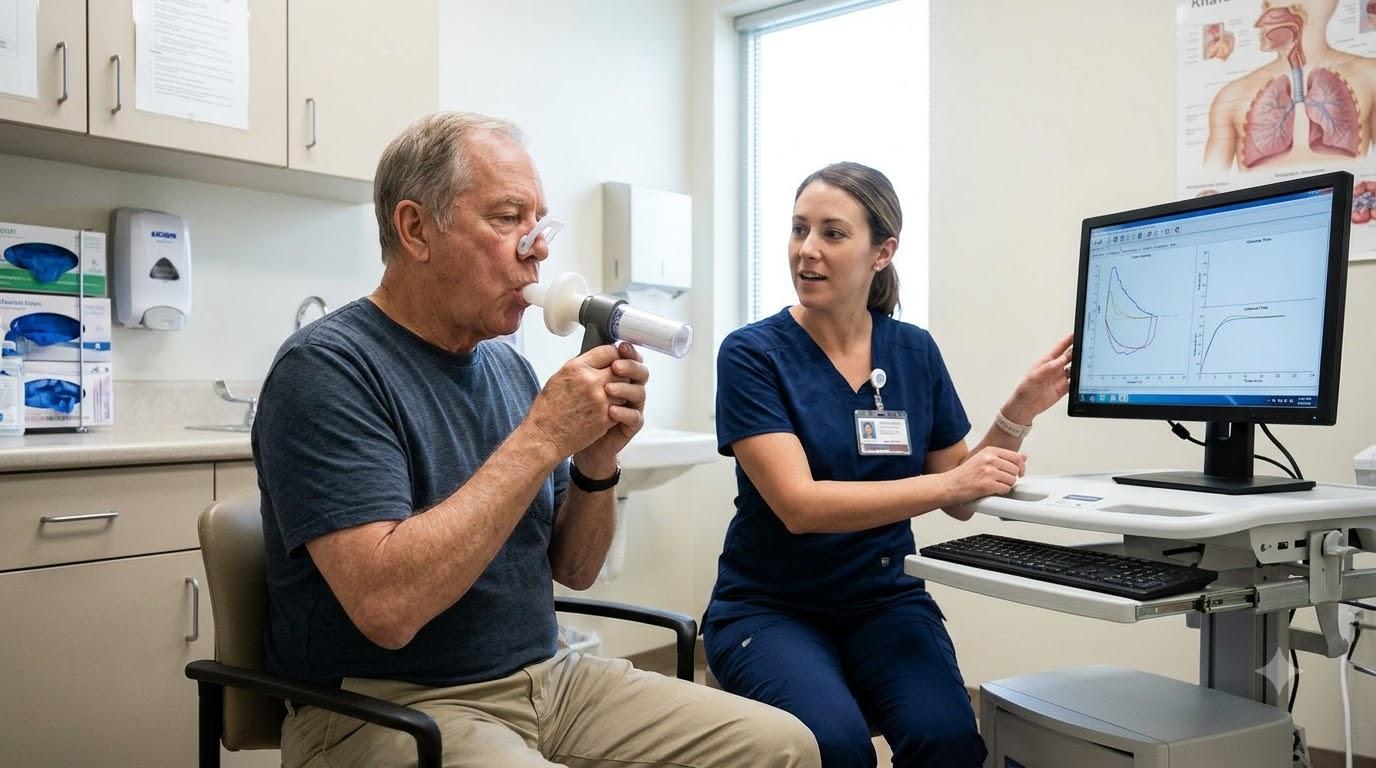
During spirometry, you will generally sit upright and breathe through a mouthpiece connected to a measuring instrument. The technician explains how to take a deep breath and exhale forcefully.
Several attempts may be needed to obtain acceptable measurements. The technician may provide coaching on technique and ask you to repeat the manoeuvre.
If bronchodilator response testing has been requested, the procedure may include a medicine followed by a waiting period and repeat measurements. The timing and medication instructions depend on the testing protocol.
Some people experience temporary coughing, fatigue, or light-headedness during forced breathing. Tell the technician if you feel uncomfortable or need a break.
The assessment itself does not usually require needles or surgery. However, your clinician should consider your health and any relevant limitations before deciding which procedure is appropriate.
Understanding the Results Without Jumping to Conclusions
Asthma test reports can contain numerical values that are difficult to interpret without clinical context.
FEV1 describes the volume of air exhaled during the first second of a forced breath. FVC describes the total volume forcibly exhaled after a deep inhalation. The relationship between these values helps clinicians assess airflow obstruction.
An improvement after bronchodilator medicine may provide evidence of variable airflow limitation. Nevertheless, the significance of the result depends on the measurement quality, the testing method, and the overall clinical picture.
A normal spirometry result does not always rule out asthma. If symptoms are intermittent, the measurements may be normal at the time of testing. A clinician may recommend further assessment if the history remains suggestive.
An abnormal result also does not prove asthma by itself. Other respiratory conditions can affect airflow, which is why professional interpretation is important.
Ask the clinician three practical questions:
-
What do my results suggest in relation to my symptoms?
-
Is any additional investigation necessary?
-
Should my current treatment or follow-up plan change?
Do not alter prescribed medicines solely because a report appears normal or abnormal.
Two Practical Examples
Example 1: Symptoms Occur Mainly at Night
A hypothetical patient experiences coughing and occasional wheezing at night but feels well during a daytime appointment.
A normal result during testing may not fully explain the symptom pattern. The clinician reviews the history, checks how and when the test was performed, and decides whether repeat testing or another assessment is appropriate.
Lesson: The timing of symptoms can be important when investigating a condition that varies over time.
Example 2: Breathing Difficulties During Exercise
Another hypothetical patient notices chest tightness during physical activity. The patient assumes that any breathing test will immediately establish whether asthma is responsible.
The clinician first reviews the symptom pattern and other possible causes. Appropriate testing is then selected, and the results are interpreted alongside the patient's medical history.
Lesson: A symptom-triggered pattern helps guide investigation, but it does not establish a diagnosis without appropriate assessment.
Illustrative Case Study: Investigating Variable Breathing Symptoms
Initial problem: A hypothetical adult experiences recurring wheezing, but the symptoms are not present every day.
Circumstances: The patient seeks testing after noticing that symptoms sometimes occur around environmental triggers. A single symptom-free day does not explain the recurring problem.
Solution: A healthcare professional reviews the history and recommends an appropriate lung function assessment.
Steps taken: The patient discusses current medicines, follows the testing instructions, completes the prescribed procedure, and returns for review of the findings. If the results do not resolve the diagnostic question, the clinician considers whether further investigation is justified.
Expected outcome: The measurements provide additional evidence to support clinical decision-making. Depending on the findings, the clinician may clarify the diagnosis, recommend additional assessment, or review the existing management plan.
Practical lesson: Asthma assessment often requires a combination of symptom history and objective measurements rather than reliance on one isolated result.
Exploring Testing Services in Bangalore
Ecotown Diagnostics lists pulmonary function testing among its diagnostic services and provides information about the booking process and available assessments. Readers can explore the Ecotown Diagnostics official website for general service information and contact details. <Cite refs={["turn771238search0","turn771238search1"]}/>
Before booking, confirm that the centre offers the specific procedure recommended by your clinician. Ask about current availability, preparation requirements, pricing, and report delivery.
The diagnostic facility performs the assessment, but a qualified healthcare professional should interpret the findings and decide whether they support an asthma diagnosis or indicate a need for further evaluation.
Common Mistakes to Avoid
-
Assuming that wheezing automatically means asthma.
-
Stopping inhalers without medical advice before testing.
-
Expecting one normal result to rule out every respiratory condition.
-
Ignoring symptom patterns because they are absent during the appointment.
-
Changing treatment based on an isolated report value.
-
Booking a basic test without checking whether additional procedures were prescribed.
Avoiding these mistakes supports a more informed and safer diagnostic process.
Conclusion
Pulmonary function testing can provide valuable information when a clinician investigates suspected asthma or monitors an existing diagnosis. The most useful approach combines appropriate testing, careful preparation, an accurate symptom history, and professional interpretation.
If you need a pulmonary function test for asthma in Bangalore, confirm the recommended procedure before booking and discuss medication instructions with your healthcare professional. Use the report as part of a broader medical assessment rather than treating it as a diagnosis on its own.
Frequently Asked Questions
1. Can spirometry confirm asthma?
Spirometry can provide important evidence of airflow obstruction and variability, particularly when measurements improve after a bronchodilator. The diagnosis depends on the overall clinical assessment and may require additional testing.
2. Can asthma be present when a PFT is normal?
Yes. Lung function measurements can be normal when symptoms are absent, particularly in conditions involving variable airflow. A clinician may consider repeat or alternative assessments when the symptoms remain suggestive.
3. Should I use my asthma inhaler before the test?
Follow the specific instructions given by your clinician or testing team. Do not stop prescribed treatment independently, even if you have been told that certain medicines can affect test results.
4. Is the test suitable for children?
Pulmonary function testing may be used in children when they are able to perform the required manoeuvres and the assessment is clinically appropriate. The method depends on the child's age, ability, and medical circumstances.
5. How long does an asthma-related PFT take?
The duration depends on the test and whether measurements are repeated after medication. Confirm the expected appointment time with the diagnostic centre.
6. What should I do if symptoms continue after a normal result?
Arrange a follow-up with your healthcare professional. They can review your symptoms and the test conditions and decide whether repeat testing or another investigation is appropriate.
❤️ Support Friends Aim! View a sponsored ad to help cover our website costs. Thanks!
Support Us — Ad 1 Support Us — Ad 2- Arts, Culture & Design
- Automotive & Transport
- Accounting & Finance
- Advertising & Marketing
- Agriculture & Farming
- Business & Consulting
- Books & Publishing
- Building & Construction
- Beauty & Personal Care
- Baby, Kids & Parenting
- Charity & Social Causes
- Crafts & Handmade
- Careers & Jobs
- Computers & Laptops
- Consumer Electronics
- Entertainment & Events
- Food & Beverages
- Delivery & Logistics
- Digital Media & Content
- Dating & Relationships
- E-Commerce & Retail
- Education & Learning
- Energy & Environment
- Fitness
- Fashion & Apparel
- Gaming & Toys
- Government & Legal
- Gardening
- Health & Medical Care
- Home Decor & Furniture
- IT & Software
- Industrial & Tools
- Import & Export
- Jewelry & Watches
- Lifestyle & Wellness
- Legal Services & Law
- News & Media
- News & Current Affairs
- Religion & Faith
- Sports
- Technology
- Travel & Tourism
- Weddings & Events
- Other
❤️ Support Friends Aim! View a sponsored ad to help cover our website costs. Thanks!
Support Us — Ad 1 Support Us — Ad 2
 Arabic
 French
 Spanish
 Portuguese
 Deutsch
 Turkish
 Dutch
 Italiano
 Russian
 Romaian
 Portuguese (Brazil)
 Greek