


❤️ Support Friends Aim! View a sponsored ad to help cover our website costs. Thanks!
Support Us — Ad 1 Support Us — Ad 2How AI Implementation Services Help Businesses Automate Operations and Improve Productivity
Introduction
Businesses are increasingly exploring artificial intelligence to improve productivity, streamline operations, and make better decisions. However, adopting AI successfully requires more than purchasing software or experimenting with standalone tools. Organizations need solutions that fit their existing workflows, business objectives, and technology infrastructure.
This is where AI implementation services become valuable. They help businesses identify practical use cases, integrate AI into everyday operations, and deploy systems that address specific operational challenges. With a structured implementation process, companies can move from AI experimentation toward practical applications that support measurable business outcomes.
What Are AI Implementation Services?
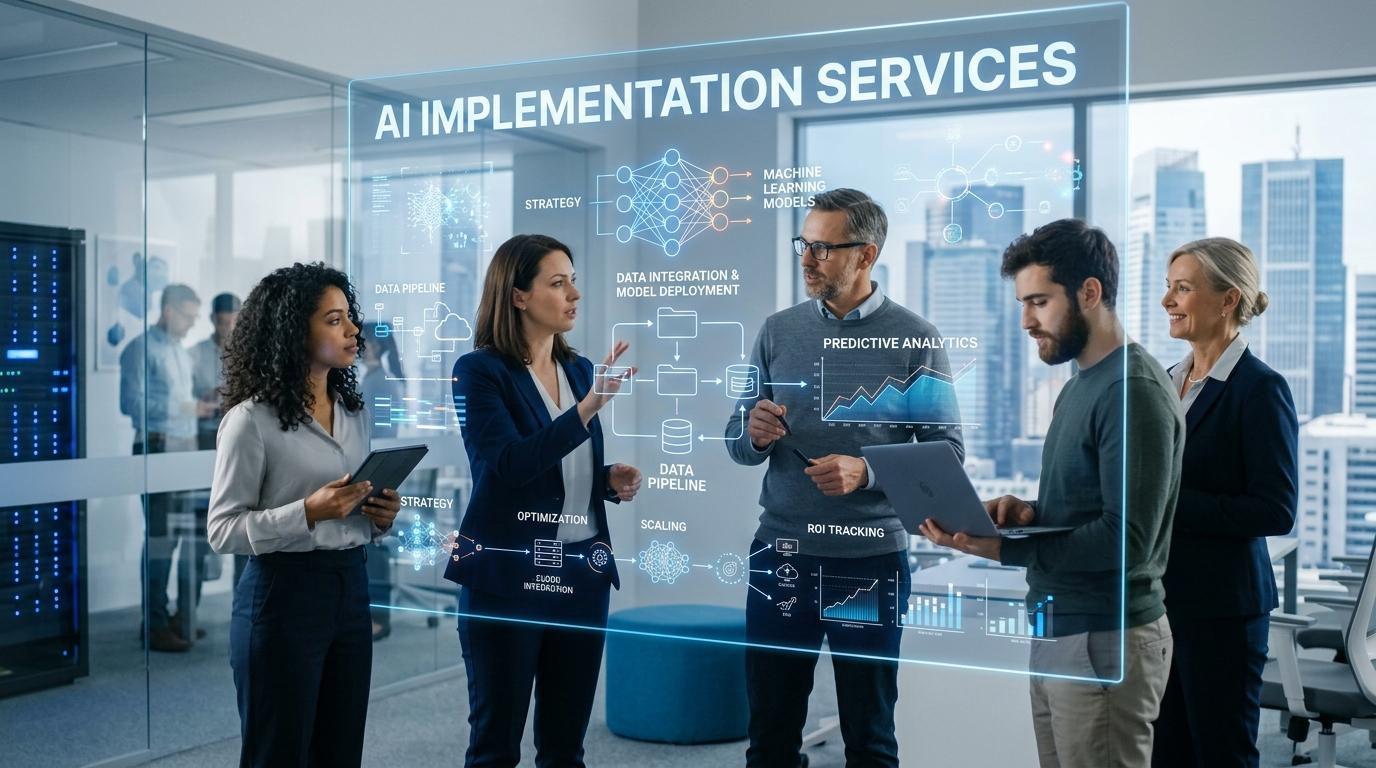
AI implementation services involve planning, developing, integrating, and deploying artificial intelligence solutions within a business. These services may include AI-powered applications, intelligent automation, customer support systems, data analysis tools, and AI agents designed to complete specific tasks.
The objective is to make AI useful within real business environments rather than treating it as an isolated technology.
Depending on the organization's needs, implementation may involve connecting AI models to existing applications, automating repetitive processes, organizing business data, or developing custom AI-powered workflows.
Five Ways AI Implementation Improves Business Operations
1. Automating Repetitive Tasks
Many businesses spend significant time on repetitive administrative activities, including data entry, document processing, report preparation, and information routing.
AI-powered workflows can help reduce this manual workload by extracting information, categorizing requests, preparing summaries, and triggering predefined actions. Employees can then focus more attention on tasks requiring judgment, communication, and problem-solving.
For example, an AI-enabled document workflow could extract relevant information from incoming invoices and send the results to an employee for verification before updating an accounting system.
2. Improving Customer Support
Customer service teams often handle recurring questions about products, orders, policies, and services. AI assistants can help answer common questions using approved business information and direct complicated requests to the appropriate employee.
When integrated with a customer relationship management platform or support system, these solutions can also help categorize tickets, summarize conversations, and organize customer inquiries.
Human oversight remains important for sensitive requests, complaints, and situations requiring exceptions to company policies.
3. Supporting Data-Driven Decisions
Businesses often collect large amounts of information across sales platforms, marketing tools, operational systems, and customer databases. Reviewing this information manually can make it difficult to identify important patterns quickly.
AI implementation can help teams summarize reports, identify trends, classify information, and retrieve answers from approved internal data sources.
These capabilities support decision-making, although recommendations should be checked against reliable data and appropriate business context.
4. Streamlining Sales and Marketing
AI can support several stages of the sales and marketing process, from initial lead handling to campaign analysis.
Potential applications include lead classification, automated follow-up reminders, customer segmentation, content research, and reporting dashboards.
For example, an AI lead-intake system can collect information from website inquiries, categorize prospects according to predefined criteria, and route qualified opportunities to the relevant sales representative.
Such systems work best when the business defines clear qualification rules and measures the quality of the leads they generate.
5. Connecting Existing Business Systems
Organizations frequently use multiple applications to manage customers, inventory, projects, finances, and internal communications. When these systems operate separately, employees may need to transfer information manually.
AI integration services can connect suitable AI capabilities with existing software through APIs, approved data connections, and automated workflows.
The result can be a more connected process in which information moves between systems with fewer unnecessary manual steps.
The AI Implementation Process
Successful AI adoption requires a structured approach that connects technical delivery with business priorities.
Step 1: Identify Business Challenges
Begin by identifying the processes that consume excessive time, create avoidable errors, or delay important decisions. Prioritize problems that can be measured rather than adopting AI simply because the technology is available.
Step 2: Evaluate Data and Infrastructure
Review the quality of available data, existing software, integration requirements, security needs, and internal technical capabilities. This assessment helps determine whether AI is appropriate for the proposed use case.
Step 3: Select the Right AI Solution
Different problems require different technologies. A business might need a conversational assistant, a document-processing system, a predictive model, a workflow automation, or a custom AI agent.
The solution should match the complexity of the task and the organization's operational requirements.
Step 4: Develop and Integrate the System
Implementation teams configure or develop the solution, connect the necessary systems, establish access permissions, and define how the AI should respond to different situations.
Testing should cover accuracy, reliability, unexpected inputs, security, and escalation procedures.
Step 5: Deploy and Measure Performance
Start with a controlled deployment where practical. Measure results against the baseline established before implementation, such as processing time, error rates, customer response time, or employee workload.
Use the findings to improve the system before expanding it across additional departments.
Common AI Implementation Challenges
Businesses may encounter several obstacles during AI adoption.
-
Poor data quality: Incomplete or inconsistent information can reduce the usefulness of AI outputs.
-
Integration difficulties: Existing software may require additional configuration or development.
-
Unclear objectives: Projects without measurable goals can become expensive experiments.
-
Employee adoption: Teams need training and clear guidance on using AI responsibly.
-
Security concerns: Access controls, data handling, and privacy requirements must be considered.
-
Unreliable outputs: AI systems can produce incorrect responses, so validation and escalation mechanisms are essential.
Addressing these challenges during planning helps organizations build solutions that are more dependable and easier to maintain.
How The Future Dynamics Supports AI Implementation
The Future Dynamics helps businesses identify practical opportunities for AI, automation, and connected digital systems. Its AI implementation offering covers areas such as AI agents, workflow automation, business process improvement, and AI transformation.
Organizations can begin by evaluating an operational bottleneck, determining whether AI is appropriate, and identifying a focused system to implement first.
Explore AI Implementation Services by The Future Dynamics to learn how AI-powered systems can support business operations and digital transformation.
Conclusion
AI implementation services help businesses translate artificial intelligence capabilities into practical operational improvements. From automating repetitive tasks to connecting existing applications, well-planned AI solutions can help teams work more efficiently and make better use of available information.
The strongest implementations begin with a clearly defined business problem, reliable data, appropriate security controls, and measurable success criteria. By following this approach, organizations can adopt AI in a controlled way and expand successful solutions as their needs evolve.
❤️ Support Friends Aim! View a sponsored ad to help cover our website costs. Thanks!
Support Us — Ad 1 Support Us — Ad 2❤️ Support Friends Aim! View a sponsored ad to help cover our website costs. Thanks!
Support Us — Ad 1 Support Us — Ad 2
 Arabic
 French
 Spanish
 Portuguese
 Deutsch
 Turkish
 Dutch
 Italiano
 Russian
 Romaian
 Portuguese (Brazil)
 Greek